
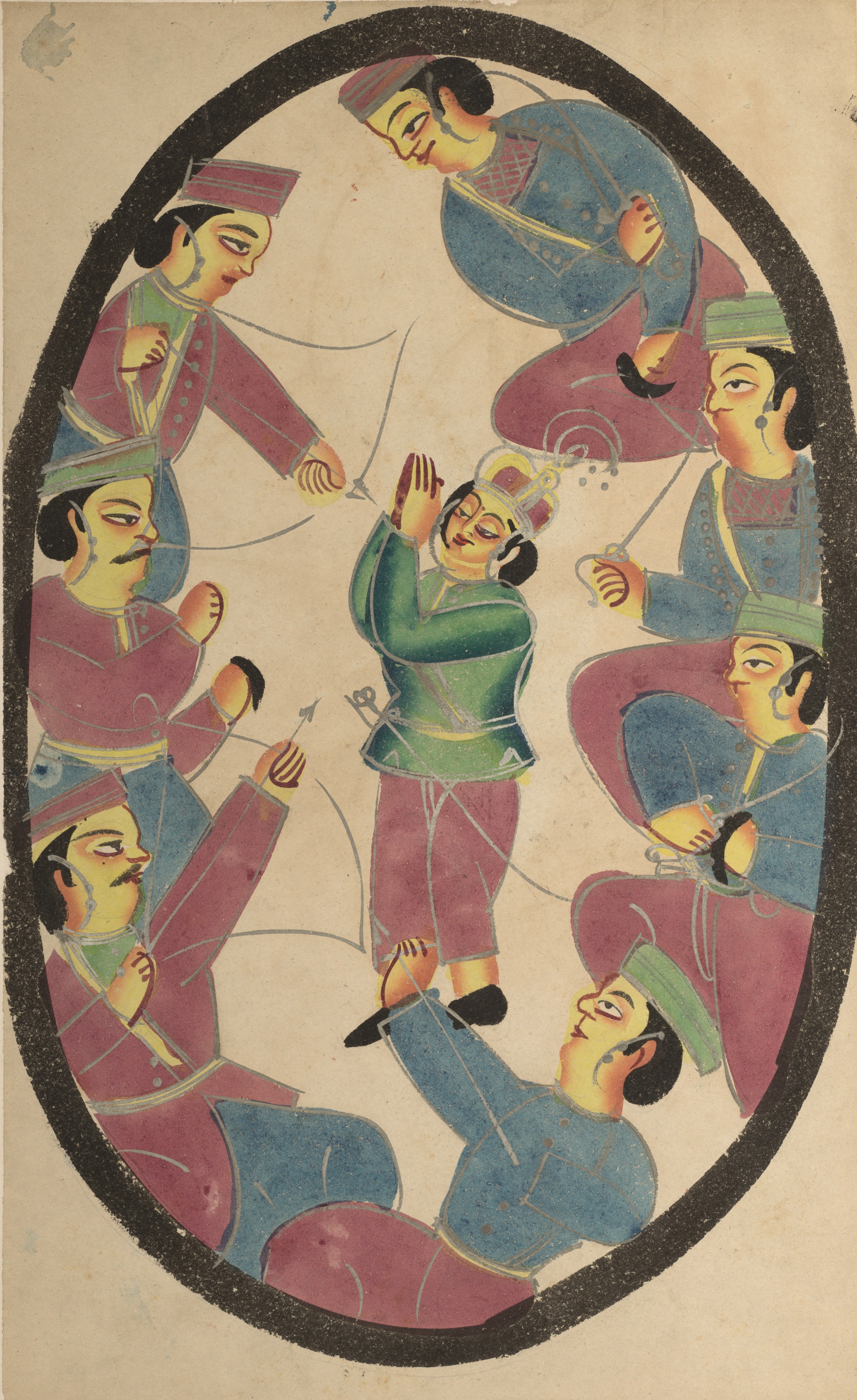
Seven Heroes or Warriors Killing Abhimanya, Son of Arjuna
Oval painting depicts seven men in battle uniforms with bows and arrows attacking a central figure. The central figure, wearing a green tunic and red pants, has one hand raised. The surrounding men are dressed in pink and blue uniforms with green headgear. They are positioned around the central figure in a semi-circle. The background of the painting is beige with a thick black border. The central figure's clothing is green and red; the attackers' clothing is pink, blue, and green.
Artwork details
- Dimensions:
- 551 × 900 px
- Museum record:
- View original
You May Also Like

Krishna Vanquishing Vanasura: Scene from the Aniruddha Usha Section of Krishna Lila

Unidentified Page from a Dispersed Bhagavata Purana (Ancient Stories of Lord Vishnu)

The vizier dissuades the king of Bahilistan from executing the dervish who asks for his daughter’s hand in marriage, from a Tuti-nama (Tales of a Parrot): Seventh Night

Megha-Nada (Indrajit, Son of Radha)

The old man eats of the fruit of the Tree of Life, but drops dead, from a Tuti-nama (Tales of a Parrot): Ninth Night

The prince’s ordeal continues, he is ordered away to be executed for the fifth time, from a Tuti-nama (Tales of a Parrot): Eighth Night

Royal Reception in a Landscape, left folio from the double frontispiece of a Shahnama (Book of Kings) of Firdausi (Persian, about 940–1019 or 1025)

Royal Reception in a Landscape, left folio from the double frontispiece of a Shahnama (Book of Kings) of Firdausi (Persian, about 940–1019 or 1025)

Krishna and the Gopis Gather for Rasamandala

Moses praying to end the serpents’ attack on the Israelites (folio 63 verso), from a Mirror of Holiness (Mir’at al-quds) of Father Jerome Xavier

The Flowering of Joseph’s Rod (folio 11 verso), from a Mirror of Holiness (Mir’at al-quds) of Father Jerome Xavier

The forty wives and their secret paramours being punished by stoning to death, from a Tuti-nama (Tales of a Parrot): Twenty-third Night

A charioteer riding through a rocky landscape with an entourage of footmen and musicians, page from a Razm-nama (Book of Wars) adapted from the Sanskrit Mahabharata and translated into Persian by Mir Ghiyath al-Din Ali Qazvini, known as Naqib Khan (Persian, d. 1614)

The rejuvenated old man and the daughter of the king of the jinns take leave of the King of Kings, from a Tuti-nama (Tales of a Parrot): Seventh Night

Grotesque Dancers Performing

Procession of a Daimyo

King Bhojaraja tries in vain to ascertain the whereabouts of the pearl from the four travelling companions, from a Tuti-nama (Tales of a Parrot): Twelfth Night

Celebrations of Krishna's Birth, from a Bhagavata Purana

Three suitors fight amongst themselves for the hand of the devotee’s daughter, from a Tuti-nama (Tales of a Parrot): Twentieth Night

The court of the Raja of Ujjain, from a Tuti-nama (Tales of a Parrot): Forty-sixth Night

Salome Receiving John the Baptist’s Head on a Platter (folio 112 verso), from a Mirror of Holiness (Mir’at al-quds) of Father Jerome Xavier

The Actors Nakamura Sukegoro II as Matano no Goro (right), Onoe Kikugoro I as Soga no Taro (center), and Otani Hiroji III as Kawazu no Saburo (left), in the Play Myoto-giku Izu no Kisewata, Performed at the Ichimura Theater in the Eleventh Month, 1770

The king of the Ocean, having assumed human form, arrives at the court of the Raja, from a Tuti-nama (Tales of a Parrot): Eleventh Night

Ragini Desakh of Meghamalhar