
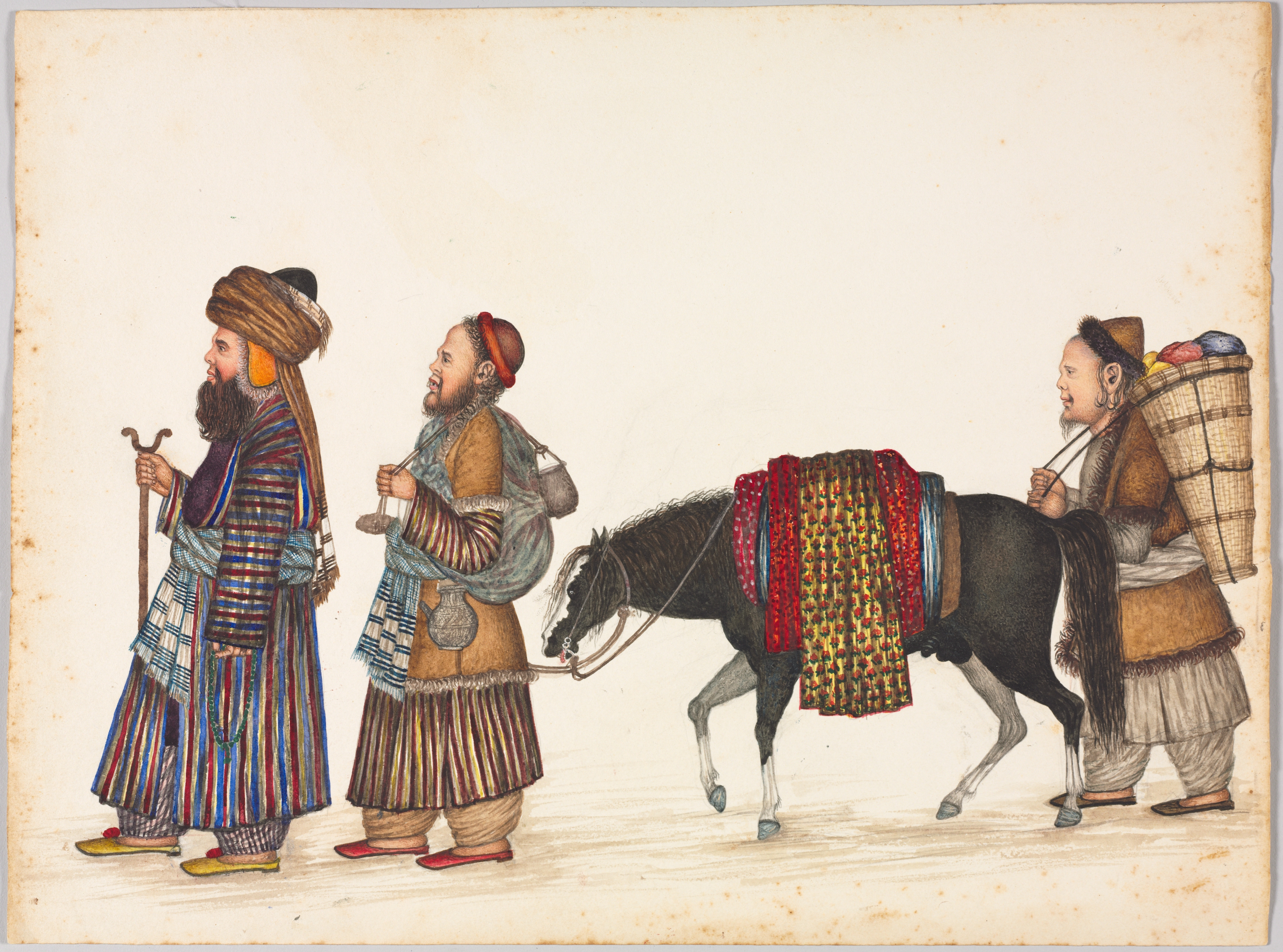
A Family of Tartars
The painting "A Family of Tartars" by an unknown artist depicts a scene with three men and a donkey. The man on the left wears a brown turban, a striped robe with blue, red, and white colors, and holds a cane. The second man from the left wears a red headband, a brown coat and striped pants, and carries a bag over his shoulder and a rope in his hand. The donkey, positioned in the center, has a colorful blanket on its back and a basket on its head. The man on the right wears a fur hat, a brown jacket, and white pants. The background of the painting is off-white. The image shows a group of people dressed in traditional clothing. The overall scene appears to depict a family of Tartars traveling or transporting goods.
Artwork details
- Dimensions:
- 1203 × 893 px
- Museum record:
- View original
You May Also Like

Equestrian Portrait of Maharana Raj Singh II of Mewar (r. 1755–62)

Femmes musulmanes Syriennes à Beyrouth, Costume de Ville

Mary and Joseph Travel to Bethlehem (folio 24 verso), from a Mirror of Holiness (Mir’at al-quds) of Father Jerome Xavier

The Emperor Alamgir (reigned 1658–1707) on Horseback

Raja Riding a Horse

Sindhu (Saindhava) Ragaputra of Shri Raga, from a Ragamala

The Entry into Jerusalem (folio 156 recto), from a Mirror of Holiness (Mir’at al-quds) of Father Jerome Xavier

Jhujhar Singh on Horseback

Sultan Abdullah Qutb Shah (1614-74) on Horseback

Six Horses

Maharao Ram Singh II of Kota (r. 1828–66) Hunting Buffalo

The Magi Follow the Star (folio 34 recto), from a Mirror of Holiness (Mir’at al-quds) of Father Jerome Xavier

“America,” from the series Five Nations

A charioteer riding through a rocky landscape with an entourage of footmen and musicians, page from a Razm-nama (Book of Wars) adapted from the Sanskrit Mahabharata and translated into Persian by Mir Ghiyath al-Din Ali Qazvini, known as Naqib Khan (Persian, d. 1614)

Portrait of Hafiz Abd al-Rahim Khan

Kalki Avatar, the Future Incarnation of Vishnu: Page from a Dispersed Manuscript

Seven men disputing possession of a woman bring her before the Tree of Justice into which she is absorbed, from a Tuti-nama (Tales of a Parrot): Sixth Night

The pious man’s son presents the slain dragon to the king, from a Tuti-nama (Tales of a Parrot): Fifty-second Night

Review of Troops at the Aoyama Training Grounds
Review of Troops at the Aoyama Training Grounds
Review of Troops at the Aoyama Training Grounds

The dervish brings the King of Kings before the king of Bahilistan, from a Tuti-nama (Tales of a Parrot): Seventh Night

Young Man on a Horse

Equestrian Portrait of a Noble