
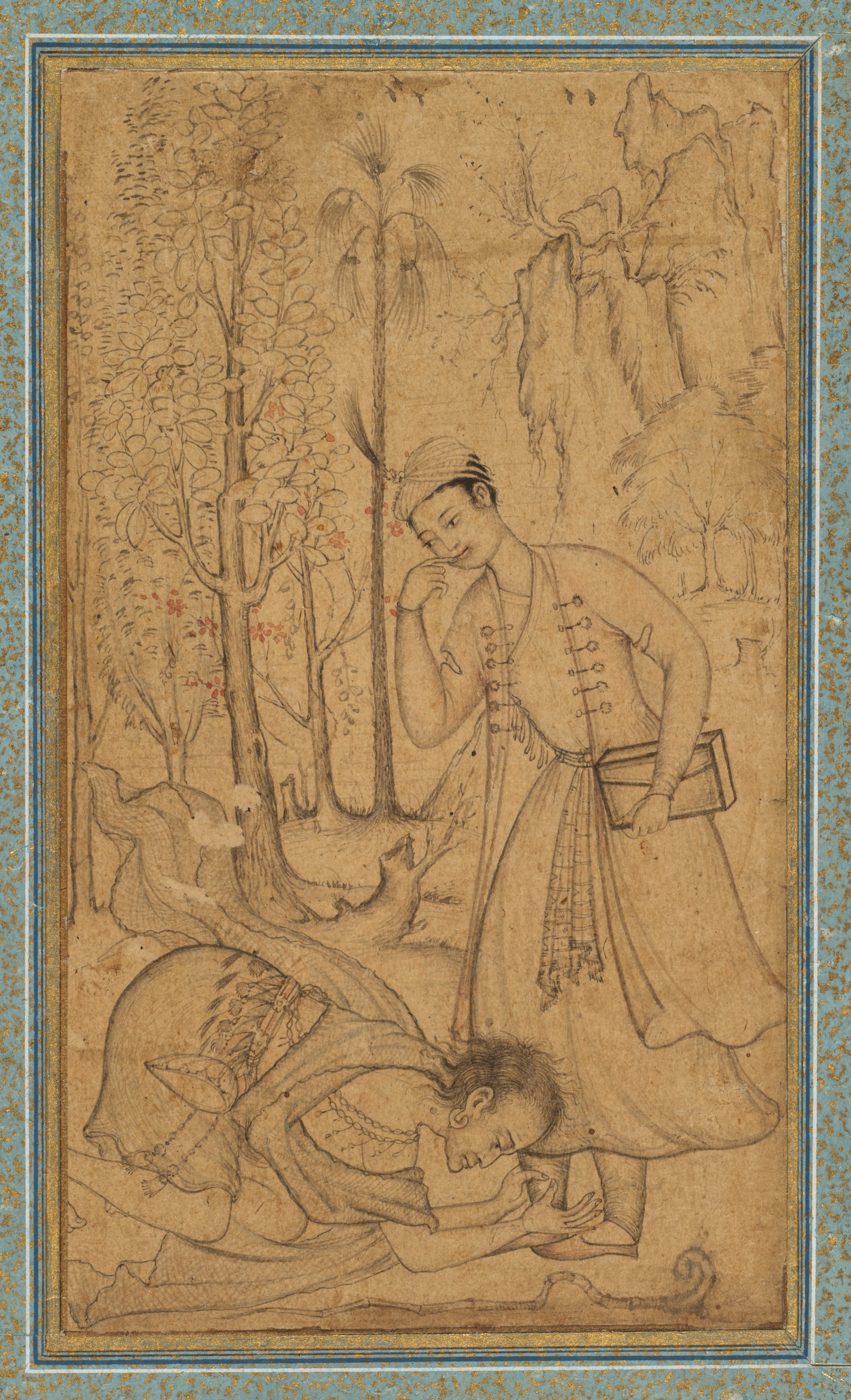
A drawing depicts a scene with two men. One man lies on the ground with his head to the right and his body extending to the left. He wears a long-sleeved garment and a turban. The other man stands over him, to his right. The standing man looks down. He wears a vest with buttons, a long skirt, and a head covering. The standing man holds a book under his left arm and his right hand is to his face. The background includes trees and a rocky area. The drawing has a light brown color with a blue and gold border.
Artwork details
- Dimensions:
- 547 × 900 px
- Museum record:
- View original
You May Also Like

A mendicant bowing before a holy man, from the Prince Salim Album

A prince visiting a holy man in a rocky landscape

The Actors Matsumoto Koshiro II as Osada no Taro Kagemune Disguised as the Woodcutter Gankutsu no Gorozo (right), and Ichikawa Danzo III as I no Hayata Tadazumi (left), in the Play Nue no Mori Ichiyo no Mato, Performed at the Nakamura Theater in the Eleventh Month, 1770

Shrine Attendant Raking Maple Leaves

A scene of the life of Alexander from the Sharaf-nameh

The Actors Nakamura Nakazo I as Matsukaze (right), Ichikawa Komazo II as Ariwara no Yukihira (center), and Iwai Hanshiro IV as Murasame (left), in the Play Kuni no Hana Ono no Itsumoji, Performed at the Nakamura Theater in the Eleventh Month, 1771

Kabir and Two Followers on a Terrace (recto)

Leaf from a Book of Hours: The Annunciation

Maharaja Anup Singh of Bikaner (reigned 1669–98) Receives a Courtier

Samantabhadra on an Elephant with Two Attendants

Beauties

The Actors Nakamura Nakazo I as Taira no Kiyomori (right), and Yamashita Kinsaku II as Tokiwa Gozen (left), in the Play Nue no Mori Ichiyo no Mato, Performed at the Nakamura Theater in the Eleventh Month, 1770

The Actors Bando Zenji I as Nagahashi Saburo, Iwai Hanshiro IV as Otatsu-gitsune, Nakamura Konozo as Hagai Ujitsune, and an Unidentified Actor (right to left), in the Play Nue no Mori Ichiyo no Mato, Performed at the Nakamura Theater in the Eleventh Month, 1770

Woman and attendant at entrance gate of Enoshima

Akutagawa

Parody of the play "Musume Dojoji"

Fujisawa, from an untitled series of the fifty-three stations of the Tokaido

A woman mistakes a cow for the Angel of Death, from a Lights of Canopus (Anwar-i Suhaili) of Kashifi (Iranian, d. 1504)

A prince riding a composite elephant

Bhima's Consultation with the Astrologer: Scene from the Nala-Damayanti Drawings

Persian Couplets (recto); Sleeping Youth (verso)

Kongara-doji

Ichimura Takenojo and Sanjo Kantaro as a Pair of Lovers in the Yoshiwara

Royal Reception in a Landscape, right folio from the double frontispiece of a Shahnama (Book of Kings) of Firdausi (Persian, about 940–1019 or 1025) (verso)