
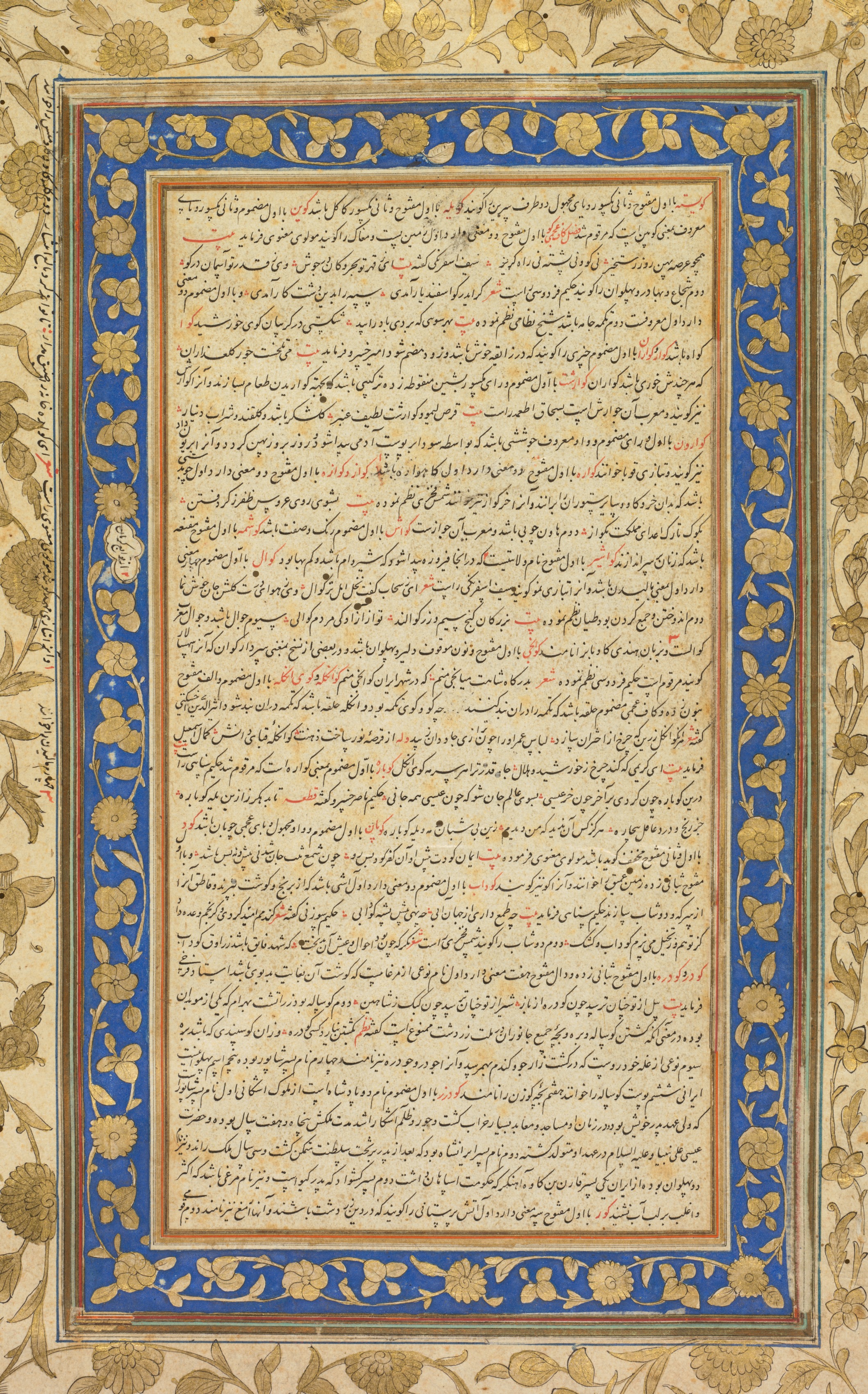
An Illuminated Folio from the Royal Manuscript of the Farhang-i Jahangiri (recto)
The image depicts a rectangular piece of aged paper with intricate designs and text. The paper's background is a light beige color. **Border Description:** A thick blue border surrounds the paper, adorned with gold floral patterns. The border features a repeating design of flowers and leaves in gold, with a thin red line running along the inner edge of the blue border. A thinner gold border is positioned between the blue border and the text area. **Text Area:** The central text area contains black cursive writing, likely in Arabic or Persian script. The text is densely packed, covering most of the page, and includes occasional red accents. **Background:** The background of the image features a gold floral pattern, which appears to be a continuation of the design on the blue border. This pattern is visible around the edges of the paper, extending beyond the blue border. **Overall Appearance:** The image presents an ornate and decorative piece of artwork, likely created using traditional techniques such as calligraphy and illumination. The use of gold, blue, and red colors adds to its visual appeal.
Artwork details
- Dimensions:
- 561 × 900 px
- Museum record:
- View original
You May Also Like

From the Farhang-i Jahangiri (Persian-language Dictionary) compiled by Mir Jamal al-Din Husayn Inju of Shiraz (Persian, d. 1626)

Text Page, Persian Verses (verso) in an Anthology with some verses from Haft Awrang (Seven Thrones) of Jami; The Fifth Throne Yusuf and Zulaykha

An Illuminated Folio from the Royal Manuscript of the Farhang-i Jahangiri (verso)

Preface (verso) from a double-page frontispiece of a Shahnama of Firdausi (940-1019 or 1025)

Calligraphy

Text Page, Persian Verses (recto); Bahram Gur meets Arzu, the Daughter of Mahiyar (verso)

Text Page, Persian Prose, (verso), from Majmac al-Tavarikh (A Compendium of Histories) of Hafiz-i Abru

Page from a Qur'an (recto)

The Reign of Nushirwan, the Combat between the Khan of Chin and the Haitalians (verso) from a Shahnama (Book of Kings) of Firdausi (940–1019 or 1025)

Persian ruba‘i (quatrain) by Maulana Muḥammad Murshidi Zawara’i (Persian, late 1500s–early 1600s) (verso)

The Story of Hushang (recto), Illustration and text (Persian Prose) from Majmac al-Tavarikh (A Compendium of Histories) of Hafiz-i Abru; Text Page, Persian Prose, (verso), from Majmac al-Tavarikh (A Compendium of Histories) of Hafiz-i Abru

Persian Couplets (recto), Calligraphy, Persian Verses; Single Page Manuscript

Persian verses from a Haft Awrang (Seven Thrones) of Jami (d. 1492) (recto)

Text Page, Persian Verses (recto) from the Shahnama of Firdawsi

Text in Khamsa of Nizami (verso), from a Haft Paykar (Seven Portraits) of Nizami

Calligraphy, Persian Verses (verso)

School Exercise Alphabet

Text page from a Mirror of Holiness (Mir’at al-quds) of Father Jerome Xavier

Text, Folio 9 (verso), from a Mirror of Holiness (Mir’at al-quds) of Father Jerome Xavier

Text page from a Mirror of Holiness (Mir’at al-quds) of Father Jerome Xavier

Folio from a Persian Manafi‘ al-Hayawan (The Benefits of Animals) of Abu Said Ubaid-Allah ibn Jibrail ibn Bakhtishu (died 1058–68) (verso)

Illuminated folio (verso) from a Gulistan (Rose Garden) of Sa'di (c. 1213–1291)

Text page from a Mirror of Holiness (Mir’at al-quds) of Father Jerome Xavier

Text page from a Mirror of Holiness (Mir’at al-quds) of Father Jerome Xavier