
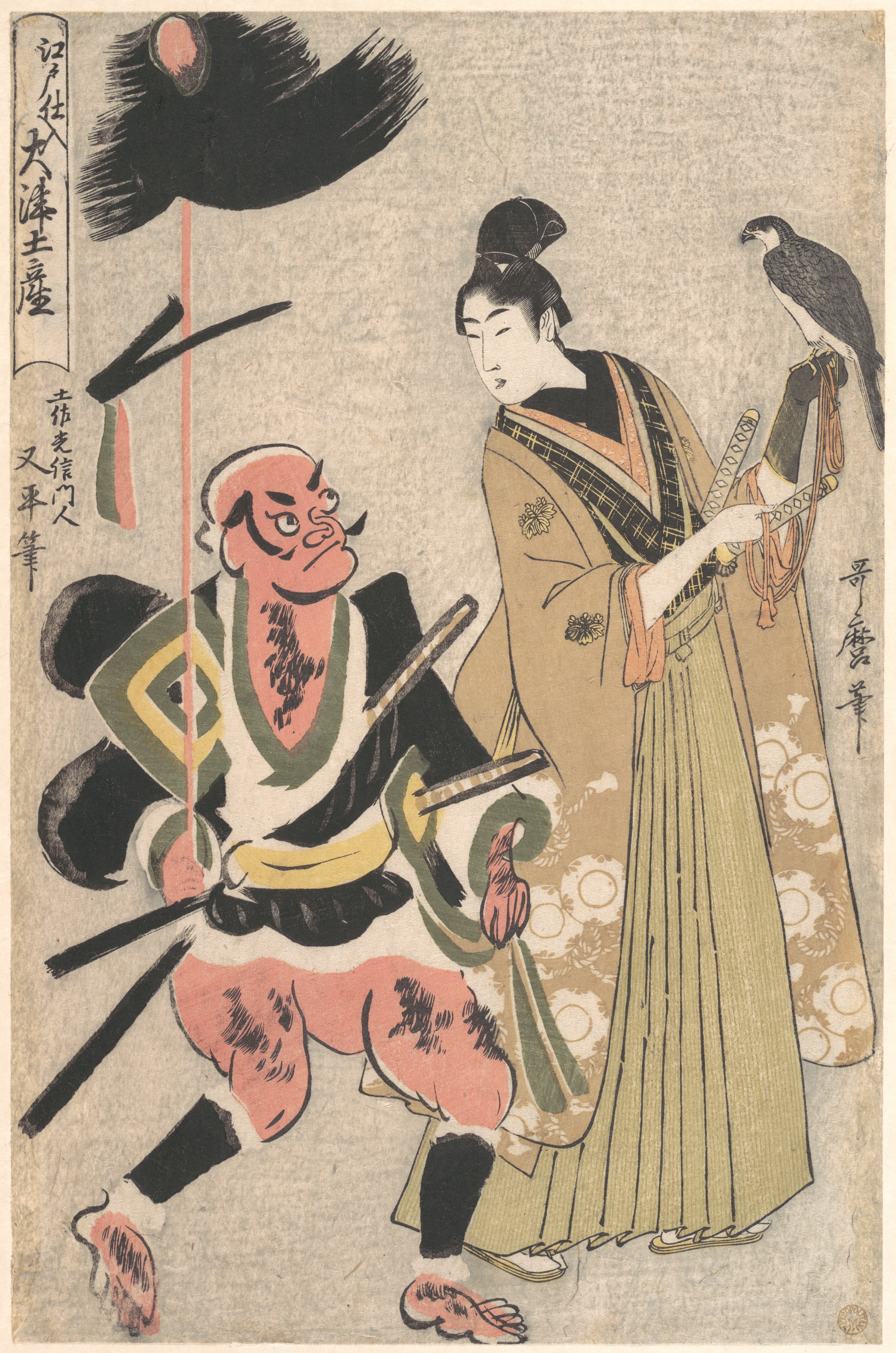
Souvenir Paintings from Ōtsu, Stocked in Edo (Edo shi-ire Ōtsu miyage) Foot-soldier with a Spear and Hawk-handler (Yari mochi yakko to taka shō)
A bald-headed man with a thick, black chinstrap beard and mustache wearing a white, green, and black yukata with a yellow sash holds a short spear and faces to the right. He stands with his right leg forward and his weight on his left leg. The man holds a green and pink hat on a long red stick. A woman stands to the right; she wears a tan yukata with a black and gold sash. She holds a post with a hawk perched on top and looks down at the man. Both figures have dark hair. The background is tan with a white floral pattern on the woman's kimono. There is Japanese writing on the left and right sides.
Artwork details
- Date:
- ca. 1802–3
- Medium:
- Woodblock print; ink and color on paper
- Culture:
- Japan
- Dimensions:
- 413 × 624 px
- Museum record:
- View original
You May Also Like

The Strange Occurrence of Ukiyo Matahei and his Famous Paintings

The Actors Sawamura Sojuro II and Ichimura Kichigoro in Unidentified Roles

The Actor Ichikawa Yaozo II as a Samurai

The Actor Ichikawa Yaozo II in the Role of Soga no Goro

The Actor Ichikawa Yaozo II as Yoshimine no Munesada in the Play Kuni no Hana Ono no Itsumoji, Performed at the Nakamura Theater in the Eleventh Month, 1771

Scene from the Drama "Soga Moyo Aigo no Wakamatsu"

Ichikawa Yaozo II as Soga no Goro

Portrait of Ichimura Takenojō and Sanjō Kantarō

The Actor Nakamura Kumetaro I as a Oiran

The actors Arashi Sanpachi I and Ichikawa Omezo I

The Actor Nakamura Nakazo with Drawn Sword

Bando Matataro as Umewomaru in the Drama "Sugewara denju tenarai Kagami"

Ichikawa Danjuro IV in the Role of Okazaki Akushiro

A Daimyo Talking to One of His Retainers

Ichikawa Danjūrō V as Kūdo no Suketsune, and Nakamura Rikō as Oiso no Tora

The Actors Yamashita Kinsaku II as Mutsuhana (right), Bando Mitsugoro I as Kashiwagi no Emon (center), and Nakamura Sukegoro II as Akamatsu Mushanosuke (left), in the Play Fuki Kaete Tsuki mo Yoshiwara (Rethatched Roof: The Moon also Shines Over the Yoshiwara Pleasure District), Performed at the Morita Theater in the Eleventh Month, 1771

Ichikawa Danjuro V (1741–1806) with Sword and Fan


The Actor Nakamura Juzo II in an Unidentified Role

The Second Nakamura Juzo as a Samurai of High Rank

The Actors Fujita Hananojo and Ichikawa Danjuro II

A Foreigner and a Leopard Disguised as a Woman

Nakamura Nakazo II as Prince Koretaka disguised as the farmer Tsuchizo in the play "Intercalary Year Praise of a Famous Poem (Uruo Toshi Meika no Homare)," performed at the Miyako Theater in the eleventh month, 1794

The Portrait of Actors at the Ogura Cottage


