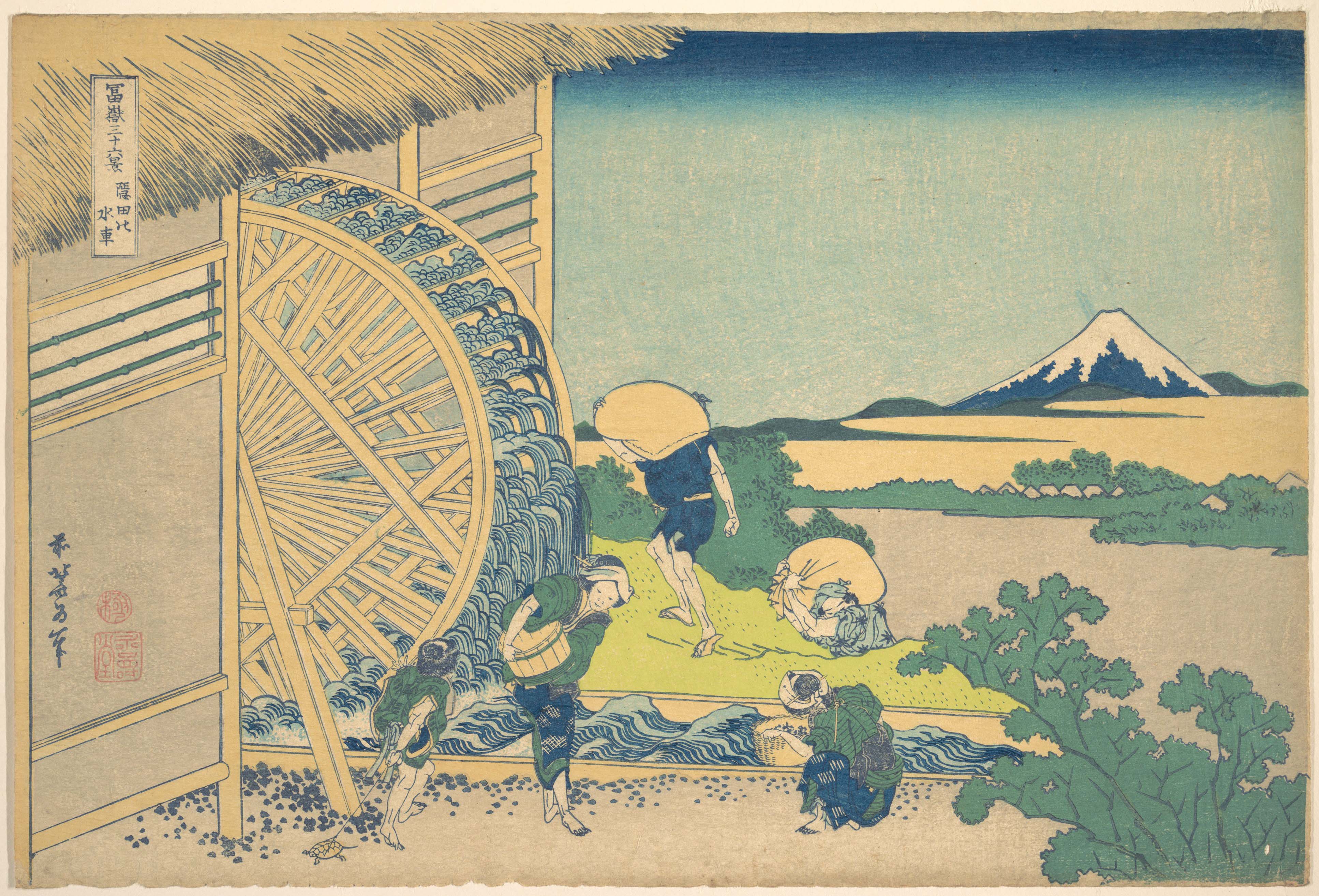
The Waterwheel at Onden (Onden no suisha), from the series Thirty-six Views of Mount Fuji (Fugaku sanjūrokkei)
A woodblock print depicting a scene with a large waterwheel. The waterwheel is on the left side of the image and is made of light-colored wood with a series of spokes. It appears to be in motion, with water splashing at the bottom. Three men are standing on the right side of the waterwheel, one of them bending over. They are dressed in traditional Japanese clothing. A body of water and a mountain with snow on its peak are in the background. The mountain is symmetrical and conical in shape. There are green bushes in the foreground on the right side. A thatched roof is above the waterwheel. The sky above is blue and fades to dark at the top.
Artwork details
- Date:
- ca. 1830–32
- Medium:
- Woodblock print; ink and color on paper
- Culture:
- Japan
- Dimensions:
- 599 × 407 px
- Museum record:
- View original
You May Also Like

The Waterwheel at Onden (Onden no suisha), from the series Thirty-six Views of Mount Fuji (Fugaku sanjūrokkei)

Waterwheel at Onden (Onden no suisha), from the series "Thirty-six Views of Mount Fuji (Fugaku sanjurokkei)"

The Waterwheel at Onden (Onden no suisha), from the series Thirty-six Views of Mount Fuji (Fugaku sanjūrokkei)

Poem by Tenchi Tennō, from the series One Hundred Poems Explained by the Nurse (Hyakunin isshu uba ga etoki)

Lower Meguro (Shimo Meguro), from the series Thirty-six Views of Mount Fuji (Fugaku sanjūrokkei)

Yoshiwara

Lower Meguro (Shimo Meguro), from the series "Thirty-six Views of Mount Fuji (Fugaku sanjurokkei)"

The Village of Yase (Yase no sato), from the series "Famous Places in Kyoto (Kyoto meisho no uchi)"

Fujieda

Poem by Emperor Tenchi, from the series One Hundred Poems by One Hundred Poets Explained by the Nurse

Poem by Dainagon Tsunenobu (Minamoto no Tsunenobu, Katsura no Dainagon), from the series One Hundred Poems Explained by the Nurse (Hyakunin isshu uba ga etoki)

Tenji Tenno (The Emperor Tenji), first poet in the series One Hundred Poems by One Hundred Poets Explained by the Nurse

Lower Meguro (Shimo Meguro), from the series Thirty-six Views of Mount Fuji (Fugaku sanjūrokkei)

No. 66: Echikawa, from the series "Sixty-nine Stations of the Kisokaido (Kisokaido rokujukyu tsugi no uchi)"

Fall of Aoiga Oka, Yedo

Poem by Jitō Tenno (Empress Jitō), from the series One Hundred Poems Explained by the Nurse (Hyakunin isshu uba ga etoki)

東海道五十三次 藤枝

東海道五十三次 沼津

Ariwara no Narihira, from the series A True Mirror of Chinese and Japanese Poems

Dainagon Tsunenobufrom the series One Hundred Poems Explained by the Nurse (Hyakunin isshu uba ga etoki)

Harumichi no Tsuraki, thirty-second poet in the series One Hundred Poems by One Hundred Poets Explained by the Nurse

Ejiri in Suruga Province (Sunshu Ejiri), from the series "Thirty-six Views of Mount Fuji (Fugaku sanjurokkei)"

No. 42: Midono, from the series "Sixty-nine Stations of the Kisokaido (Kisokaido rokujukyu tsugi no uchi)"

Tsuchiyama: Suzuka Mountains in the Rain (Tsuchiyama, Suzukayama uchu no zu), from the series "Fifty-three Stations of the Tokaido (Tokaido gojusan tsugi no uchi)," also known as the Gyosho Tokaido


