
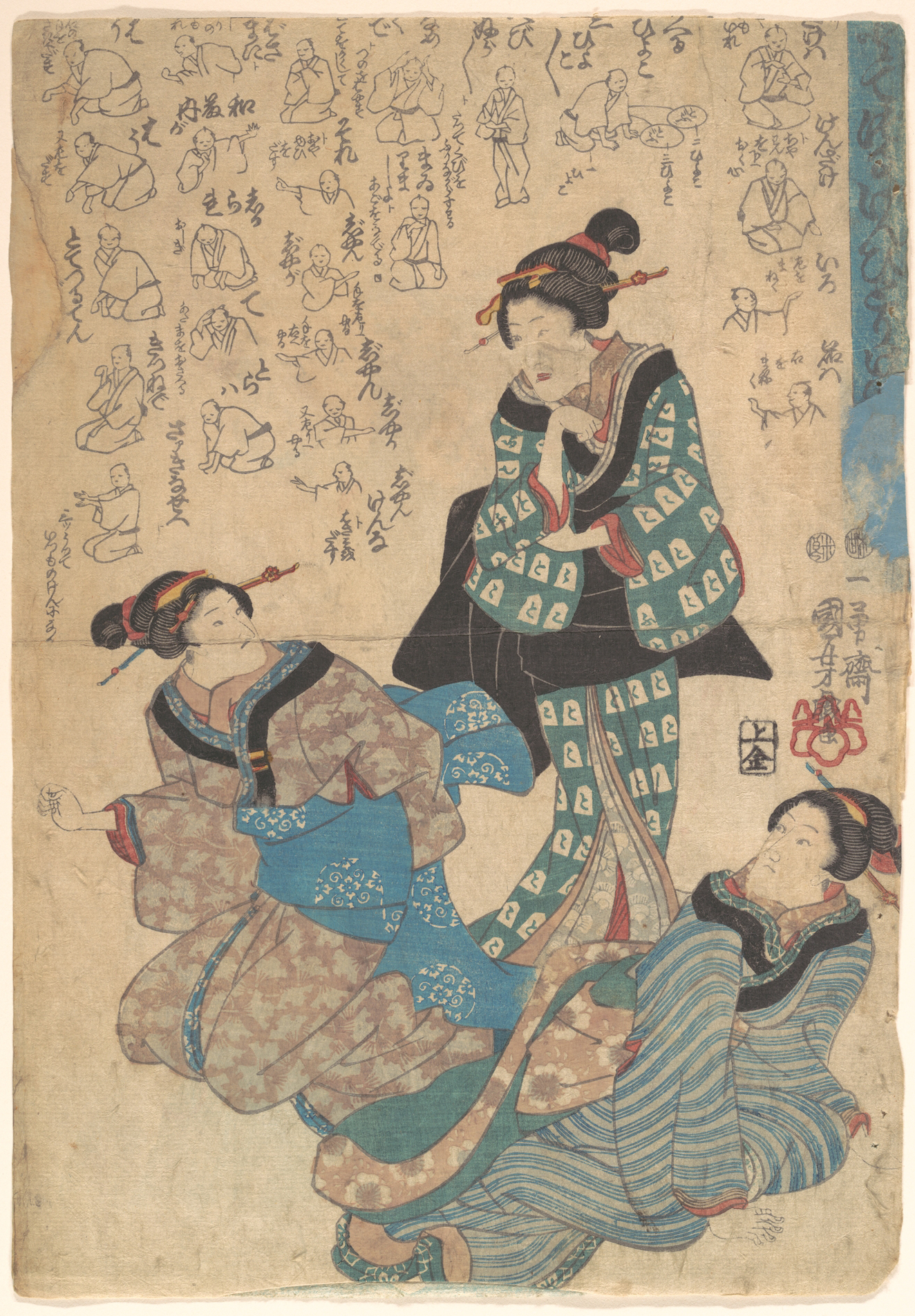
Colorful Japanese woodblock print featuring three women. The woman on the right is reclining on the ground; she wears a blue and gray striped kimono with a black obi. The woman on the left is bending over; she wears a beige kimono with a blue obi and a beige floral pattern. The woman in the back wears a black kimono with green and white squares and a red and yellow obi. The background is beige and includes Japanese writing and 56 small illustrations. The right side of the print has blue along the edge. The print is titled and by Utagawa Kuniyoshi.
Artwork details
- Date:
- 19th century
- Medium:
- Woodblock print; ink and color on paper
- Culture:
- Japan
- Dimensions:
- 434 × 624 px
- Museum record:
- View original
You May Also Like

The Actor Segawa Kichiji as a Daimyo's Young Son, and Sanogawa Ichimatsu as a Samurai Attendant


The Actors Bando Aizo as the courtesan Kewaizaka no Shosho and Ichikawa Raizo I as Soga no Goro in the play "Satsuki Matsu Unohana Soga," performed at the Morita Theater in the fourth month, 1766


The Courtesans Hanamurasaki and Koshikibu of the Tamaya Promenading in the Rain

A New Series of Fifty Poets' Stanzas of the Temmei Period; A Bookcase of Humorous Poems in the Azuma (i.e. Edo) Style

Reading a Letter in Front of a Screen, from an untitled series of 12 prints

Two Lovers, Oshichi and Kichisaburo

Hour of the Tiger (Tora no koku), from the series "Twelve Hours in Yoshiwara (Seiro juni toki tsuzuki)"

Hakoōmaru, Buyū chikara-gusa

The Actors Ichikawa Komazo II as Minamoto no Yorimasa (right), Matsumoto Koshiro II as Osada no Taro Kagemune Disguised as Yatsurugi Zaemon (center), and Ichikawa Danzo III as I no Hayata Tadazumi (left), In the Play Nue no Mori Ichiyo no Mato, Performed at the Nakamura Theater in the Eleventh Month, 1770

The Actors Nakamura Kiyosaburo I as Okiku and Ichimura Kamezo I as Kosuke in the play "Hiyoku no Kagamon," performed at the Ichimura Theater in the seventh month, 1751

Hour of the Sheep (Hitsuji no koku), from the series "Twelve Hours in Yoshiwara (Seiro juni toki tsuzuki)"

A Boat upon the Waters

Beauties Parodying the Seven Sages - A Selection of Younger Courtesans (Shichi kenjin yatsushi bijin shinzo zoroe): Shinoura of the Tsuruya

On the Yoshida Highway

Courtesan with Sake Cup and Scroll

Street Scene in the Springtime

The Actors Arashi Koroku I as Makomo no Mae and Ichikawa Uzaemon VIII as Taira no Koremochi in the play "Shusse Momijigari," performed at the Ichimura Theater in the eleventh month, 1747

Kiyomizu Komachi from the series Little Seedlings: Seven Komachi

The Actors Segawa Kikunojo II as Itsuki and Bando Hikosaburo II as Oyamada Taro in the play "Taiheiki Shizunome Furisode," performed at the Nakamura Theater in the eleventh month, 1767

Two Women and a Girl


The Courtesan Sugatami of the Tsuruya Brothel, from the series “A Pat-tern Book of the Year’s First Designs, Fresh as Spring Herbs” (“Hinagata wakana no hatsu moyō”)


