
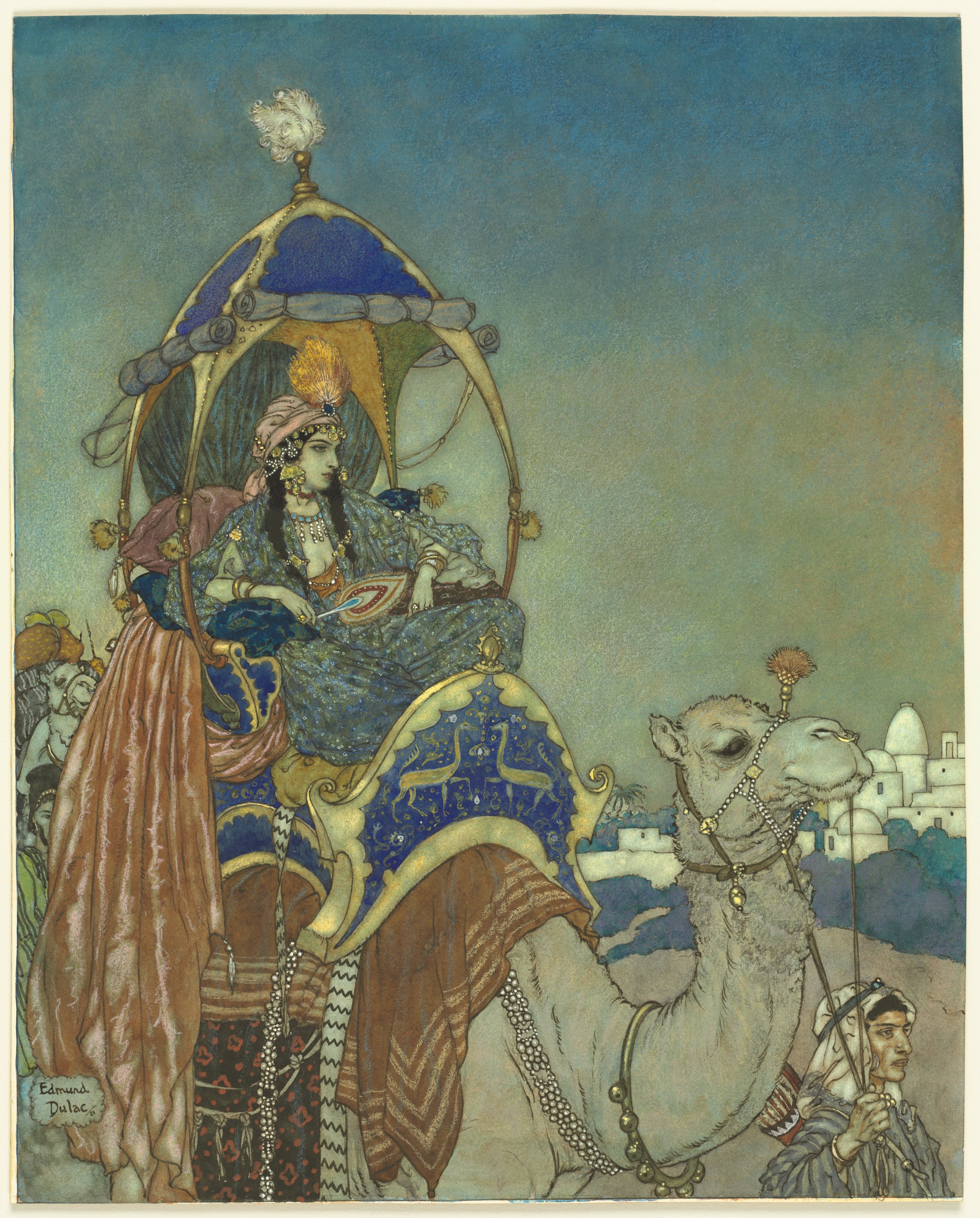

The Queen of Sheba, a woman with light skin and long dark hair, sits in a decorated carriage on top of a camel. The carriage is gold with blue panels and gold trim. The woman wears a pink turban with a gold and blue headpiece and a blue dress. The camel is light brown with a brown and white blanket underneath the carriage. A woman with a white headscarf and a blue dress walks to the right of the camel, holding a spear. In the background, there are buildings with white walls and domed roofs. The sky is blue and green.
Artwork Details
- Dimensions
- 718 × 893 px
- Museum Record
- View original
You May Also Like

Equestrian Portrait of Maharana Raj Singh II of Mewar (r. 1755–62)

Kalki Avatar, the Future Incarnation of Vishnu

The Emperor Alamgir (reigned 1658–1707) on Horseback

Raja Riding a Horse

Kalki Avatar, the Future Incarnation of Vishnu: Page from a Dispersed Manuscript

A prince riding a composite elephant

Equestrian Portrait of Maharana Bhim Singh

Krishna and the Kshatriya Maidens Proceed to Dvaraka: page from a Bhagavata Purana series

Raja Gulab Singh

Mahant of Tarakeshwar Rides on an Elephant

Maharana Jagat Singh II in Procession

Akbar and Jahangir Examine a Ghir Falcon while Prince Khusrau Stands Behind

Maharaja Abhai Singh of Marwar (reigned 1724–49), Equestrian, Watching Girls Swinging at the Teej Festival

Sultan Abdullah Qutb Shah (1614-74) on Horseback

Jai Singh III of Jaipur (r. 1818–1835) Riding

Prince Mathu Singh of Jatoli on a Blue Horse Riding to Udaipur

The Magi Follow the Star (folio 34 recto), from a Mirror of Holiness (Mir’at al-quds) of Father Jerome Xavier

Enthroned Rama and Sita receive homage from their monkey and bear Allies, from the Yuddha Kanda (Book of the War) of a Ramayana (Rama’s Journey)

Raja on Horseback Accompanied by His Favorite Attendants

Bijan killing the wild boars of Irman, from a Shah-nama (Book of Kings) of Firdausi (Persian, about 934–1020)

Shiva and Devi on Gajasura's Hide

The Parrot Addresses Khujasta at the Beginning of the Seventh Night, from a Tuti-nama (Tales of a Parrot)

A charioteer riding through a rocky landscape with an entourage of footmen and musicians, page from a Razm-nama (Book of Wars) adapted from the Sanskrit Mahabharata and translated into Persian by Mir Ghiyath al-Din Ali Qazvini, known as Naqib Khan (Persian, d. 1614)

Review of Troops at the Aoyama Training Grounds