
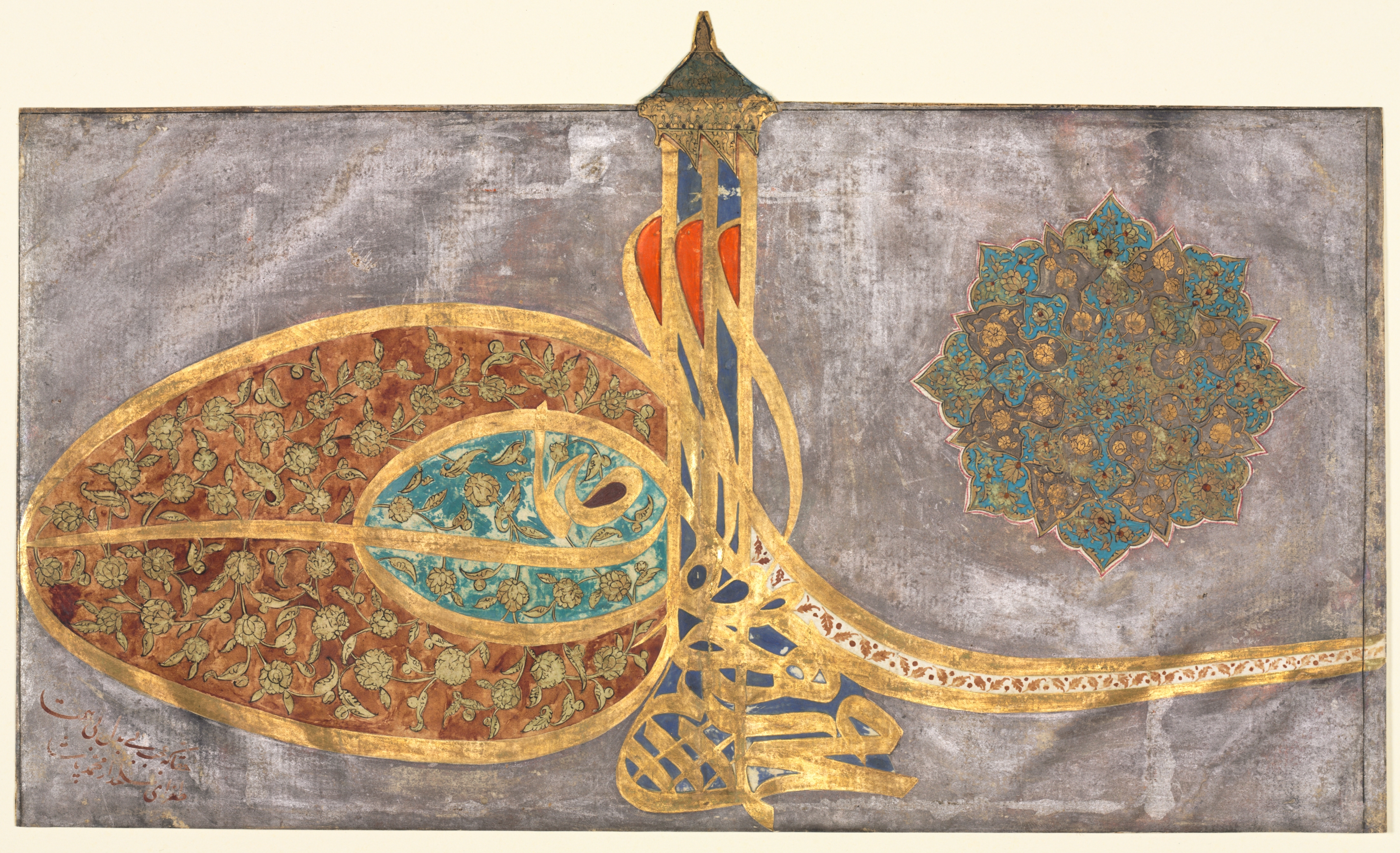
Tughra: Shah Muhammad bin Ibrahim Khan, al-muzaffar daima (Sultan Mehmed, son of Ibrahim Khan, the eternally victorious; Calligraphy (Ottoman Turkish Signature), Single Page Manuscript
The image depicts a single-page manuscript with intricate calligraphy and design. The background of the manuscript is gray with a textured appearance. A large, teardrop-shaped design dominates the left side, featuring a brown base with gold floral patterns and a blue circle at its center, also adorned with gold floral patterns. The teardrop shape is outlined in gold. A long, curved line extends from the teardrop, featuring gold calligraphy and decorative elements in blue, red, and gold. The line terminates in a gold flourish at the bottom right. A smaller, starburst-shaped design with blue, gold, and brown patterns is positioned on the right side. The top of the manuscript features a small, pyramid-shaped design in blue and gold. The overall design is ornate, with extensive use of gold, blue, red, and brown colors. The calligraphy and decorative elements suggest an Ottoman Turkish origin. The image is rectangular, with a cream-colored border around the edges.
Artwork details
- Dimensions:
- 1263 × 770 px
- Museum record:
- View original
You May Also Like

Persian Quatrains (Rubayi) and Calligraphic Exercises (recto)

Persian Verse (khamriyya) (verso)

Qur'an Manuscript Folio (Recto); Left Folio of Double-Page Illuminated Frontispiece

Calligraphy from a Ghazal of Badr al-Din Hilali Jaghata’i (Persian, active c. 1500)

Illuminated Leaf with Writing by Muhammad Ali

Persian ruba‘i (quatrain) by Maulana Muḥammad Murshidi Zawara’i (Persian, late 1500s–early 1600s) (verso)

Calligraphy of Chaghatai Turkish Poems in Praise of Wine (verso)

Illuminated page (verso), from a Panj Ganj (Five Treasures) of Abd al- Rahman Jami (Persian, 1414–1492) with two Persian masnavis: Yusuf va Zulaykha (Joseph and Zulaykha) and Khirad-nama-i Iskandari (Alexander’s Book of Wisdom)

Prayer Niche (Mihrab)

Calligraphy of Lyrical Quatrains (verso)

Qur'an Manuscript Folio (Verso); Right folio of Double-Page Illuminated Frontispiece

Qur'an Manuscript Folio

Calligraphy of a ghazal of Amir Khusrau Dihlavi (Indian, 1253–1325) (verso)

Persian calligraphy framed by an ornamental border of flowers, birds, and deer, from the Late Shah Jahan Album

Calligraphy of a Pious Invocation in Rhyme (verso)

Calligraphy (verso)

Calligraphy of a Quatrain (verso)

Calligraphy, Persian Verses (verso)

Yusuf and Zulaykha (recto); Text Page, Persian Verses (verso)

The Story of Nushirwan and his Minister, "The Third Discourse on Diverse Events and Disorder in Life" from a Khamsa (Quintet) of Nizami (1141-1209) (verso)

Qur'an Manuscript Folio (recto; verso); Left side of Bifolio

Calligraphy, Persian Verses (verso)

Shamsa (sunburst) with portrait of Aurangzeb (1618–1707), from the Emperor's Album (the Kevorkian Album)

Folio B: Folio from the "Five Treasures" (Panj Ganj) of Jami (recto)