
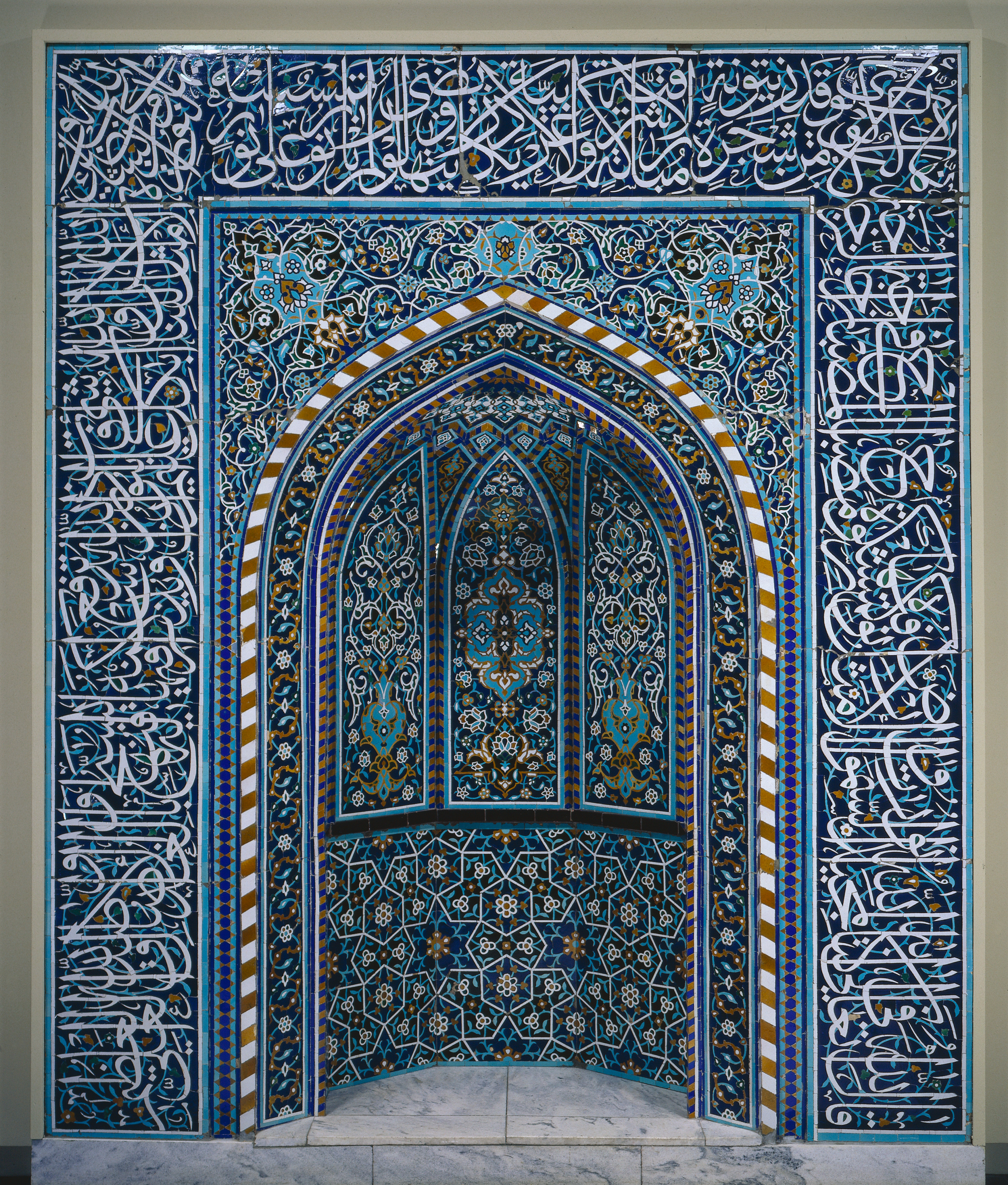
Prayer Niche (Mihrab)
Large, ornate archway with a pointed top. The archway is made of blue, white, gold and brown tiles. The archway is surrounded by intricate designs and patterns. The archway has a small step in front of it. The walls around the archway are beige. The archway is made up of many small, detailed tiles. The tiles are arranged in a pattern of geometric shapes and floral designs. The archway is very ornate and decorative. The archway appears to be a prayer niche, known as a mihrab, created by an unknown artist.
Artwork details
- Dimensions:
- 766 × 900 px
- Museum record:
- View original
You May Also Like

Qur'an Manuscript Folio (Recto); Left Folio of Double-Page Illuminated Frontispiece

Qur'an Manuscript Folio (Verso); Right folio of Double-Page Illuminated Frontispiece

Qur'an Manuscript Folio

Persian Quatrains (Rubayi) and Calligraphic Exercises (recto)

Persian ruba‘i (quatrain) by Maulana Muḥammad Murshidi Zawara’i (Persian, late 1500s–early 1600s) (verso)

Illuminated page (verso), from a Panj Ganj (Five Treasures) of Abd al- Rahman Jami (Persian, 1414–1492) with two Persian masnavis: Yusuf va Zulaykha (Joseph and Zulaykha) and Khirad-nama-i Iskandari (Alexander’s Book of Wisdom)

Tughra: Shah Muhammad bin Ibrahim Khan, al-muzaffar daima (Sultan Mehmed, son of Ibrahim Khan, the eternally victorious; Calligraphy (Ottoman Turkish Signature), Single Page Manuscript

Illuminated Leaf with Writing by Muhammad Ali

Calligraphy of Lyrical Quatrains (verso)

Calligraphy from a Ghazal of Badr al-Din Hilali Jaghata’i (Persian, active c. 1500)

Persian Verse (khamriyya) (verso)

Calligraphy of Chaghatai Turkish Poems in Praise of Wine (verso)

Calligraphy of a ghazal of Amir Khusrau Dihlavi (Indian, 1253–1325) (verso)

Calligraphy: A Page of Text from Sadi's Bustan (verso)

Wall Tile

Untitled (Jama Masjid, Delhi)

Calligraphy, Persian Verses (verso)

Shamsa (sunburst) with portrait of Aurangzeb (1618–1707), from the Emperor's Album (the Kevorkian Album)

Calligraphy of a Pious Invocation in Rhyme (verso)

King Luhrasp Ascends the Throne: a Processon Arrives at Court (recto); the Story of King Luhrasp (verso) from a Shahnama (Book of Kings) of Firdausi (940-1019 or 1025)

Persian verses from a Haft Awrang (Seven Thrones) of Jami (d. 1492) (recto)

Calligraphy, Persian Verses (verso)

Yusuf and Zulaykha (recto); Text Page, Persian Verses (verso)

A woman asks her lover to leave her house, brandishing his sword and feigning rage in order to deceive her husband who has just arrived, from a Tuti-nama (Tales of a Parrot): Eighth Night