
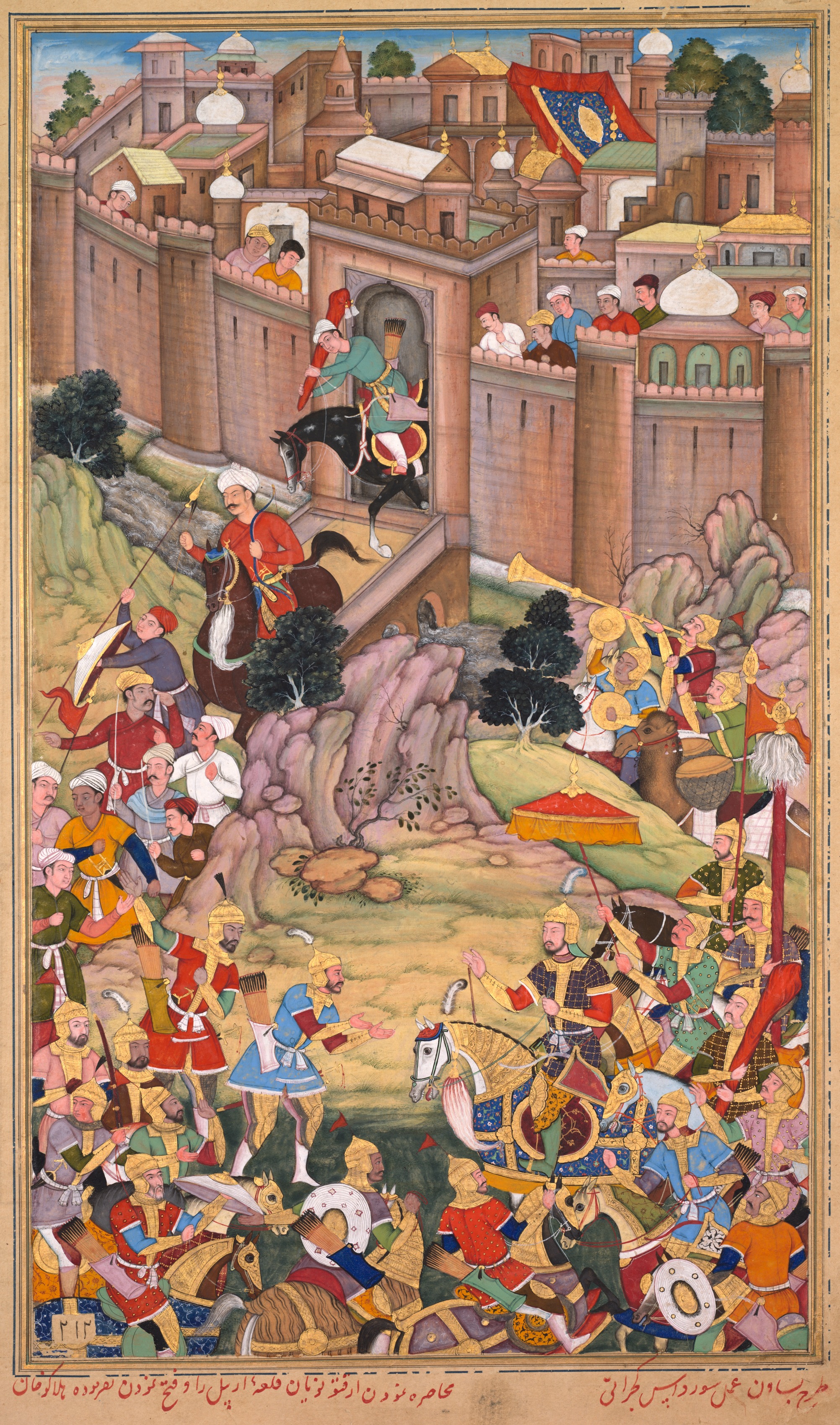
The siege of Arbela in the era of Hulagu Khan, from a Chingiz-nama (Book of Chingiz Khan) of the Jami al-tavarikh (Compendium of Chronicles) of Rashid al-Din (Persian, 1247–1318)
The painting depicts a battle scene with a large group of people. The scene shows a city with a high wall and a few towers in the background. The city wall has a gate with people standing on it. The foreground shows a group of horsemen and foot soldiers with various weapons, including swords, bows, and shields. The horsemen wear colorful clothing, including red, blue, green, and yellow. Some of the horsemen are wearing helmets or headgear. The foot soldiers are also dressed in various colors and some are holding shields. The ground is uneven, with rocks and trees scattered around. The sky above is blue. The painting is framed with a gold border. There is writing in red at the bottom of the painting.
Artwork details
- Dimensions:
- 531 × 900 px
- Museum record:
- View original
You May Also Like

The siege of Arbela in the era of Hulagu Khan, page from a Chingiz-nama (Book of Chingiz Khan) of the Jami al-tavarikh (Compendium of Chronicles) of Rashid al-Din (Persian,1247–1318)

Mughal ruler Humayun defeating the Afghans before reconquering India, folio from an Akbar-nama (Book of Akbar) of Abu’l Fazl (Indian, 1551–1602)

Kamsa deploys Akrura and Keshi to Braj, from a Bhagavata Purana

The Birth of Krishna, from a Sursagar of Surdas (Indian, c. 1480–1580)

The Young Emperor Akbar Arrests the Insolent Shah Abu’l-Maali, Page from a Manuscript of the Akbarnama

The game of wolf-running in Tabriz, from an Akbar-nama (Book of Akbar)

Babur meeting with Sultan Ali Mirza at the Kohik River, from a Babur-nama (Memoirs of Babur)

Grotesque Dancers Performing

Pleasures of the Hunt

Babur receives booty and Humayun’s salute after the victory over Sultan Ibrahim in 1526, from an Akbar-nama (Book of Akbar) of Abu’l Fazl (Indian, 1551–1602)

A charioteer riding through a rocky landscape with an entourage of footmen and musicians, page from a Razm-nama (Book of Wars) adapted from the Sanskrit Mahabharata and translated into Persian by Mir Ghiyath al-Din Ali Qazvini, known as Naqib Khan (Persian, d. 1614)

Sindhu Raga

King Luhrasp Ascends the Throne: a Processon Arrives at Court (recto); the Story of King Luhrasp (verso) from a Shahnama (Book of Kings) of Firdausi (940-1019 or 1025)

A feast for Babur hosted by his half-brother Jahangir Mirza in Ghazni in May 1505, from a Babur-nama (Memoirs of Babur)

The Entry into Jerusalem (folio 156 recto), from a Mirror of Holiness (Mir’at al-quds) of Father Jerome Xavier

King Luhrasp Ascends the Throne: a Processon Arrives at Court, recto of the left folio of a double-page composition from a Shahnama (Book of Kings) of Firdausi (940-1019 or 1025)

Circumcision ceremony for Akbar’s sons, painting 126 from an Akbar-nama (Book of Akbar) of Abu’l Fazl (Indian, 1551–1602)

King Dasaratha and His Retinue Proceed to Rama's Wedding: Folio from the Shangri Ramayana Series (Style II)

The vizier dissuades the king of Bahilistan from executing the dervish who asks for his daughter’s hand in marriage, from a Tuti-nama (Tales of a Parrot): Seventh Night

Salome Receiving John the Baptist’s Head on a Platter (folio 112 verso), from a Mirror of Holiness (Mir’at al-quds) of Father Jerome Xavier

The three young men present themselves as suitors for the hand of Zuhra, the daughter of the merchant of Kabul, from a Tuti-nama (Tales of a Parrot): Thirty-fourth Night

Enthroned Rama and Sita receive homage from their monkey and bear Allies, from the Yuddha Kanda (Book of the War) of a Ramayana (Rama’s Journey)

Shispul Arguing with Rukmini's Father, Bhishmaka, page from a Rukmini Mangal series

Maharana Sangram Singh II Hunts Hares at Naramangra