
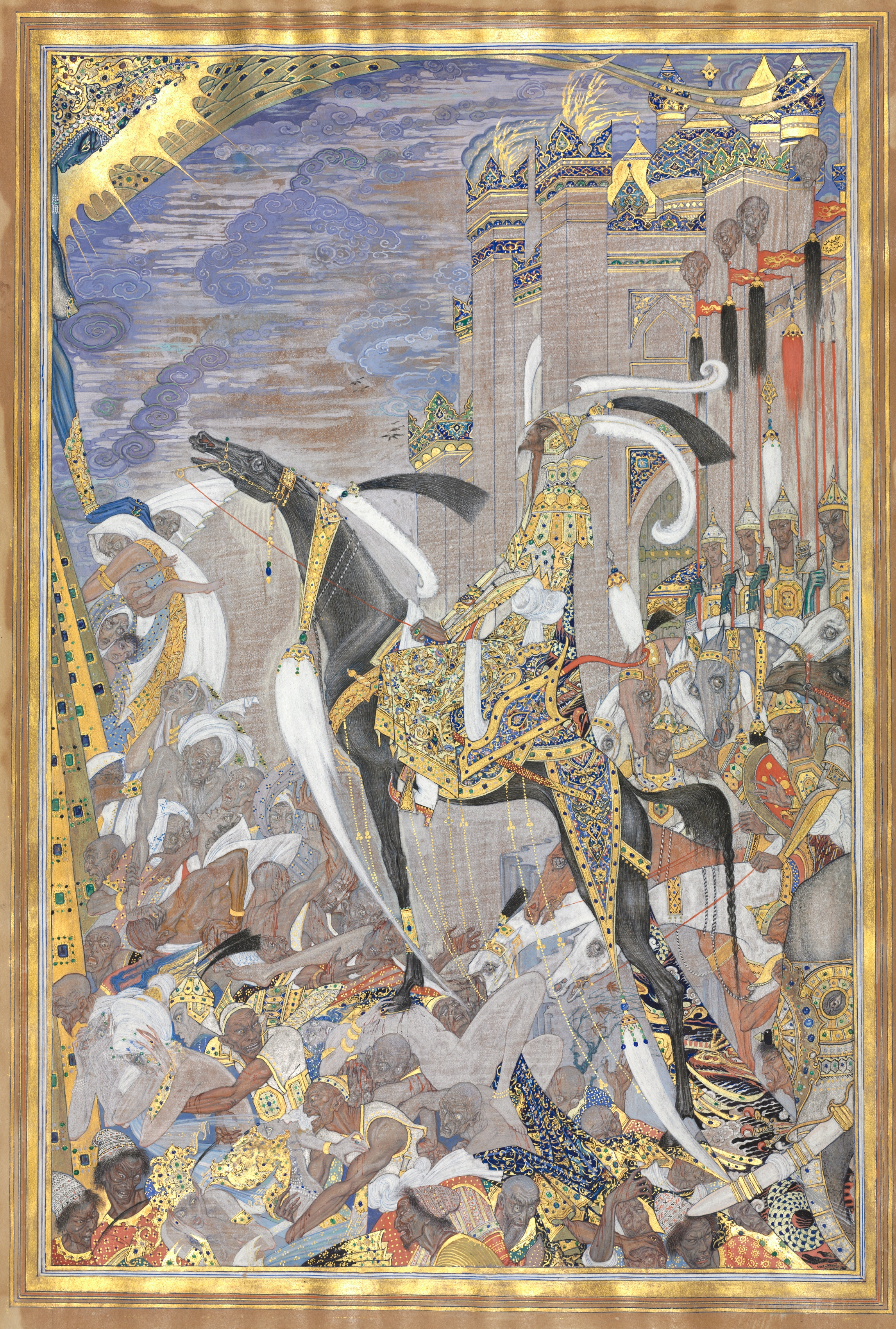
Victorious Army Entering City After Siege
The image depicts a framed painting titled "Victorious Army Entering City After Siege" by an unknown artist. The painting shows a large group of men on horseback and on foot, wearing ornate gold and white clothing and headgear, entering a city through a gate. The men on horseback wear gold crowns and ride horses with ornate gold and blue harnesses. The horses are primarily white or gray. The men on foot are dressed similarly and appear to be either fleeing or fallen. The city gate is made of stone and features gold accents. The background shows a blue sky with clouds. The painting is surrounded by a gold frame with intricate designs. The dominant colors are gold, white, blue, and gray. The scene is crowded and dynamic, with many figures and horses in motion.
Artwork details
- Dimensions:
- 602 × 893 px
- Museum record:
- View original
You May Also Like

Saint George and the Dragon

Encampment in the Mountains

Man and Woman on Horseback

Illustration of the Mahabharata

Bahram Gur and Azada, from a Shahnama (Book of Kings) of Firdausi (940-1019 or 1025)

Searching the Mountains for Demons

“America,” from the series Five Nations

A prince riding a composite elephant

King Luhrasp Ascends the Throne: a Processon Arrives at Court (recto); the Story of King Luhrasp (verso) from a Shahnama (Book of Kings) of Firdausi (940-1019 or 1025)

A charioteer riding through a rocky landscape with an entourage of footmen and musicians, page from a Razm-nama (Book of Wars) adapted from the Sanskrit Mahabharata and translated into Persian by Mir Ghiyath al-Din Ali Qazvini, known as Naqib Khan (Persian, d. 1614)

Panel from a Cassone: The Race of the Palio in the Streets of Florence

The Triumph of Caesar from The Story of Caesar and Cleopatra

King Luhrasp Ascends the Throne: a Processon Arrives at Court, recto of the left folio of a double-page composition from a Shahnama (Book of Kings) of Firdausi (940-1019 or 1025)

Bijan killing the wild boars of Irman, from a Shah-nama (Book of Kings) of Firdausi (Persian, about 934–1020)

Album of Tournaments and Parades in Nuremberg

Bahram Gur Slays a Dragon (verso), from a Shahnama (Book of Kings) of Firdausi (940-1019 or 1025), known as the Great Mongol Shahnama
![Nushirwan Listens to the Owls (recto): Illustration and Text, Persian Verses, from a Manuscript of the Khamsa of Nizami, Makhzan al-Asrar [Treasure of Secrets]](/api/image?url=https%3A%2F%2Fopenaccess-cdn.clevelandart.org%2F1944.487.a%2F1944.487.a_web.jpg&w=1536&q=75)
Nushirwan Listens to the Owls (recto): Illustration and Text, Persian Verses, from a Manuscript of the Khamsa of Nizami, Makhzan al-Asrar [Treasure of Secrets]

Initial A with the Battle of the Maccabees

Crossing at Sano

Babur meeting with Sultan Ali Mirza at the Kohik River, from a Babur-nama (Memoirs of Babur)

“Royal Hunt,” folio from a Mahabharata

Story of Perseus and Andromeda

Hunting with falcons in a landscape (recto)

Wall hanging with scene from an opera