
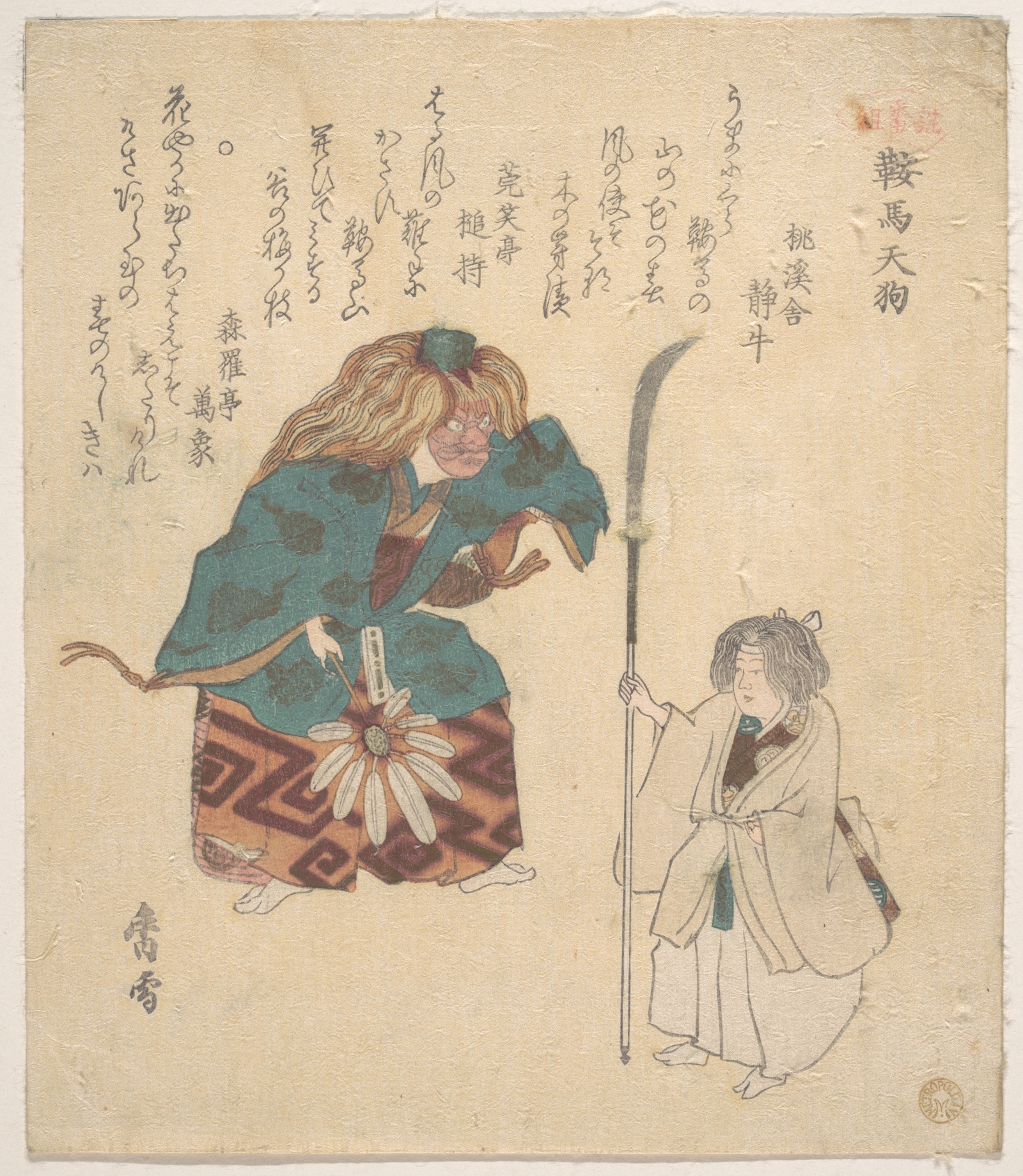
The image depicts a scene from a Noh dance by Kosetsu. The scene shows two people, one on the left and one on the right. The person on the left is a man with long blond hair and a blue-green top with darker green spots. He wears a brown skirt with a darker brown geometric pattern. The man on the left has a white daisy-like flower on his right hip. The person on the right has dark hair. The person on the right wears a beige robe and kneels on the ground while holding a long curved staff. The background is beige with black Japanese writing. The image appears to be a woodblock print with some red markings.
Artwork details
- Date:
- ca. 1820
- Medium:
- Woodblock print (surimono); ink and color on paper
- Culture:
- Japan
- Dimensions:
- 543 × 624 px
- Museum record:
- View original
You May Also Like

The Actors Otani Ryuzaemon II as Kajiwara Genta and Arashi Tominosuke I as Oiso no Tora in the play "Tamagushi Yosooi Soga," performed at the Ichimura Theater in the first month, 1747

Three (Women) Calligraphers (Sanpitsu) at a Calligraphy Reunion (Shokai)

Woman and Boy Gathering Herbs by a Plum Tree

Scene from Noh Dance


Komachi Washes the Book (from the series Seven Elegant Episodes from the Life of the Poetess Ono no Komachi)

Ebisu and Benten Walking in the Snow

The Actors Nakamura Kiyosaburo I as Okiku and Ichimura Kamezo I as Kosuke in the play "Hiyoku no Kagamon," performed at the Ichimura Theater in the seventh month, 1751

Two Ladies; One is Playing the Biwa (Japanese Lute) and the Other, the Koto (Japanese Harp)

The Actors Bando Aizo as the courtesan Kewaizaka no Shosho and Ichikawa Raizo I as Soga no Goro in the play "Satsuki Matsu Unohana Soga," performed at the Morita Theater in the fourth month, 1766

Haze on a Clear Day at Stone Bridge (From the series Eight Elegant Views of Chanted Accompanimnets for Kabuki Plays)

Snake (Mi), from the series "Parody of the Twelve Signs of the Zodiac (Mitate juni shi)"

Young Woman and Little Girl Playing Musashi

Courtesan with Two Attendants

History of Kamakura

The Actors Bando Zenji I as Nagahashi Saburo, Iwai Hanshiro IV as Otatsu-gitsune, Nakamura Konozo as Hagai Ujitsune, and an Unidentified Actor (right to left), in the Play Nue no Mori Ichiyo no Mato, Performed at the Nakamura Theater in the Eleventh Month, 1770

The Swordsmith

A New Series of Fifty Poets' Stanzas of the Temmei Period; A Bookcase of Humorous Poems in the Azuma (i.e. Edo) Style


Manzai Dancers

The Actor Sawamura Sojuro II (formerly Utagawa Shirogoro) as Matsuomaru and Azumo Tozo I as Sakuramaru in the play "Sugawara Denju Tenarai Kagami," performed at the Morita Theater, 1750

Parody of the play "Musume Dojoji"

The Second Yamashita Kinsaku in the Role of Shigenoi

Act IX (Dai kudanme): Actors Sawamura Tanosuke III as Ōboshi Rikiya and Bandō Kamezō I as Kakogawa Honzō, from the series The Storehouse of Loyal Retainers, a Primer (Kanadehon chūshingura)


