
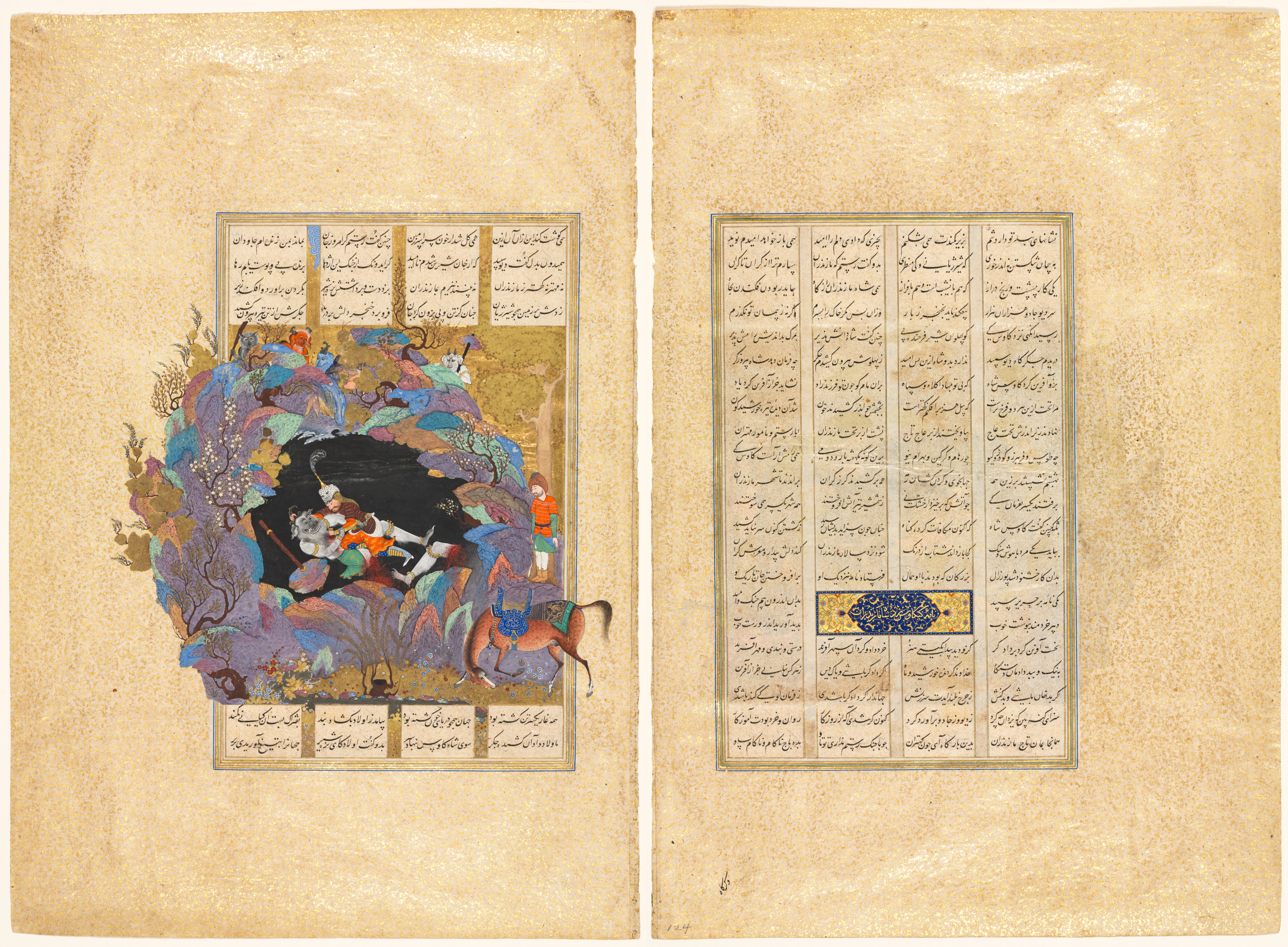
Rustam's seventh course: He kills the White Div, folio 124 from a Shah-nama (Book of Kings) of Firdausi (Persian, about 934–1020)
The image shows two pages from a book. The pages are yellowed and aged. The left page contains a colorful illustration. The illustration depicts a man on horseback stabbing another figure with a sword. The horse is brown with a blue blanket. The rider wears an orange and blue outfit. The figure being stabbed is white with black hair and wears a white outfit. There are trees and foliage around them in shades of purple, blue, green, and orange. There are four blocks of text above and one below the illustration, written in black calligraphy on a beige background. The right page contains a large block of text written in black calligraphy, divided into two columns. There is a blue and gold design in the lower third of the text block.
Artwork details
- Dimensions:
- 900 × 662 px
- Museum record:
- View original
You May Also Like

Rustam's seventh course: He kills the White Div, folio 124 from a Shah-nama (Book of Kings) of Firdausi (Persian, about 934–1020)

Bahram Gur Arrives at the House of a Merchant, text page (recto); Bahram Gur Slays a Dragon (verso), from a Shahnama (Book of Kings) of Firdausi (940-1019 or 1025), known as the Great Mongol Shahnama

Nushirwan Listens to the Owls (recto); the Story of Nushirwan and his Minister, "The Third Discourse on Diverse Events and Disorder in Life" (verso) from a Khamsa (Quintet) of Nizami (1141-1209)

Persian Verses: The Fortieth Year of King Kisra Nushirwan's Reign and the Story of Buzurgmihr (recto); Portrait of Nushirwan the Just (verso) from a Shahnama (Book of Kings) of Firdausi (940–1019 or 1025)

Nushirwan Sends Mihran Sitad to Fetch the Daughter of the King of China (Recto); The Forty-Eighth Year of Nushirwan's Reign. The Combat of the Khaqan of China with the Haithalians (Verso)

The Story of Nushirwan and his Minister, "The Third Discourse on Diverse Events and Disorder in Life" from a Khamsa (Quintet) of Nizami (1141-1209) (verso)

Rustam Lassoing his Horse, Rakhsh, in a Landscape (recto); Calligraphy, Persian Verses (verso)

Page from a Shah-nama (Book of Kings) of Firdausi (Persian, about 934–1020)

Tuti-Nama (Tales of a Parrot)

Bahram Chubineh captured by Khusrau Parviz (verso), from a Shahnama (Book of Kings) of Firdausi (940–1019 or 1025)
![Nushirwan Listens to the Owls (recto): Illustration and Text, Persian Verses, from a Manuscript of the Khamsa of Nizami, Makhzan al-Asrar [Treasure of Secrets]](/api/image?url=https%3A%2F%2Fopenaccess-cdn.clevelandart.org%2F1944.487.a%2F1944.487.a_web.jpg&w=1536&q=75)
Nushirwan Listens to the Owls (recto): Illustration and Text, Persian Verses, from a Manuscript of the Khamsa of Nizami, Makhzan al-Asrar [Treasure of Secrets]

Bijan killing the wild boars of Irman, from a Shah-nama (Book of Kings) of Firdausi (Persian, about 934–1020), (recto)

Qualities of Ringdoves (recto); On the Benefits of Quails (verso), from a Persian Manafi‘ al-Hayawan (The Benefits of Animals) of Abu Said Ubaid-Allah ibn Jibrail ibn Bakhtishu (died 1058–68)

Text Page, Persian Verses (recto); Bahram Gur meets Arzu, the Daughter of Mahiyar (verso)

Calligraphy framed by an ornamental border with poppies and pairs of birds, from the Late Shah Jahan Album (verso)

School Exercise Alphabet

School Exercise Alphabet

Calligraphy, Persian Verses (verso)

The Tale of the Twelve Faces. "The Warriors Engage in Combat": Illustration from the Firdausi Shahnama (verso)

Persian Verses: The Fortieth Year of King Kisra Nushirwan's Reign and the Story of Buzurgmihr (recto) from a Shahnama (Book of Kings) of Firdausi (940–1019 or 1025)

Piece

Bahram Gur Slays a Dragon (verso), from a Shahnama (Book of Kings) of Firdausi (940-1019 or 1025), known as the Great Mongol Shahnama

The Story of Hushang (recto), Illustration and text (Persian Prose) from Majmac al-Tavarikh (A Compendium of Histories) of Hafiz-i Abru; Text Page, Persian Prose, (verso), from Majmac al-Tavarikh (A Compendium of Histories) of Hafiz-i Abru

Ghatotkacha and three demons in his company chase Bhagadatta, from Bhishma-parva (volume six) of a Razm-nama (Book of Wars) adapted from the Sanskrit Mahabharata and translated into Persian by Mir Ghiyath al-Din Ali Qazvini, known as Naqib Khan (Persian, d. 1614)