
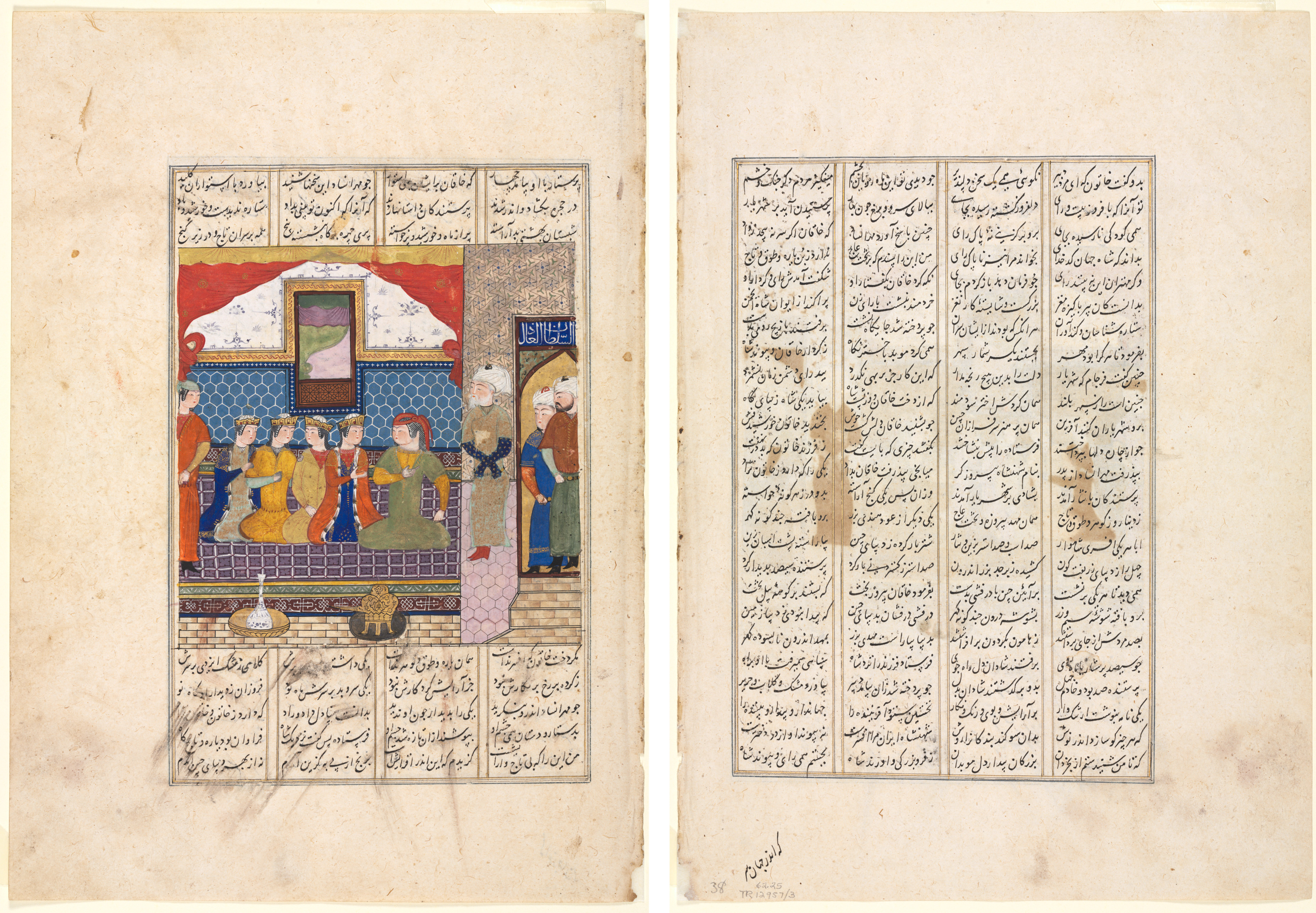
Nushirwan Sends Mihran Sitad to Fetch the Daughter of the King of China (Recto); The Forty-Eighth Year of Nushirwan's Reign. The Combat of the Khaqan of China with the Haithalians (Verso)
The image shows two pages from a book. The left page has a colorful illustration and text written in a foreign language, possibly Arabic, the illustration depicts a group of people in a room with a blue and white wall and a red background. The people are wearing various colored clothing, including yellow, blue, green, and orange. Some of them have head coverings. The right page has text written in the same language as the left page, arranged in columns. The text is black ink on a beige background. The pages appear to be old and worn, with some discoloration and staining. The left page's illustration is framed by a border with a small section of text at the top and along the bottom. The right page's text is framed in a similar way. The overall appearance suggests an antique or historical manuscript.
Artwork details
- Dimensions:
- 900 × 624 px
- Museum record:
- View original
You May Also Like

Nushirwan Listens to the Owls (recto); the Story of Nushirwan and his Minister, "The Third Discourse on Diverse Events and Disorder in Life" (verso) from a Khamsa (Quintet) of Nizami (1141-1209)

Bahram Gur Visits the Princess of India in the Black Pavilion, Illustration and Text, Persian Verses (recto); Bahram Gur Visits the Princess of India, Text Page, Persian Verses (verso)

Nushirwan Sends Mihran Sitad to Fetch the Daughter of the King of China (recto) from a Shahnama (Book of Kings) of Firdausi (940–1019 or 1025)

An Episode from the Story of the Sasanian King Khusrau and His Beloved Shirin, from a Khamsa (Quintet) of Nizami (1141–1209) (verso); Persian verses from a Haft Awrang (Seven Thrones) of Jami (d. 1492) (recto)

Tuti-Nama (Tales of a Parrot)

Yusuf and Zulaykha (recto); Text Page, Persian Verses (verso)

The Story of Hushang, from a Majma al-tavarikh (A Compendium of Histories) of Hafiz-i Abru (recto)

Text Page, Persian Verses (recto); Bahram Gur meets Arzu, the Daughter of Mahiyar (verso)

The Story of Hushang (recto), Illustration and text (Persian Prose) from Majmac al-Tavarikh (A Compendium of Histories) of Hafiz-i Abru; Text Page, Persian Prose, (verso), from Majmac al-Tavarikh (A Compendium of Histories) of Hafiz-i Abru

The Tale of the Twelve Faces. "The Warriors Engage in Combat": Illustration from the Firdausi Shahnama (verso)

Text in Khamsa of Nizami (verso), from a Haft Paykar (Seven Portraits) of Nizami

Left side of a double-page album folio: Outside a Royal Encampment (recto) and Calligraphy, Persian Verses (verso)
![Nushirwan Listens to the Owls (recto): Illustration and Text, Persian Verses, from a Manuscript of the Khamsa of Nizami, Makhzan al-Asrar [Treasure of Secrets]](/api/image?url=https%3A%2F%2Fopenaccess-cdn.clevelandart.org%2F1944.487.a%2F1944.487.a_web.jpg&w=1536&q=75)
Nushirwan Listens to the Owls (recto): Illustration and Text, Persian Verses, from a Manuscript of the Khamsa of Nizami, Makhzan al-Asrar [Treasure of Secrets]

The Tale of the Twelve Faces. "Bizhan Addresses the Army": Illustration from the Firdausi Shahnama (recto); The Tale of the Twelve Faces. "The Warriors Engage in Combat": Illustration from the Firdausi Shahnama (verso)

Persian Quatrains (Rubayi) and Calligraphic Exercises (recto); Persian Verse (khamriyya) (verso)

Kabir and Two Followers on a Terrace (recto); Calligraphy (verso)

Siyavush on His Horse Hitting a Rolling Target (recto) and Persian verses (verso), from a Shahnama (Book of Kings) of Firdausi (940–1019 or 1025)

The Reign of Nushirwan, the Combat between the Khan of Chin and the Haitalians (verso) from a Shahnama (Book of Kings) of Firdausi (940–1019 or 1025)

Episodes from the Reigns of Khusrau Parviz and Nushirwan from a Shahnama (Book of Kings) of Firdausi (940–1019 or 1025)

Khusrau Parviz Fleeing Bahram Chubineh and Being Saved by Angel Sarush (recto) from a Shahnama (Book of Kings) of Firdausi (940–1019 or 1025)

A prince conversing with a woman while taking refreshments on a terrace (recto); Calligraphy (verso)

Bahram Gur meets Arzu, the Daughter of Mahiyar (verso); Illustration and Text, Persian Verses, from the Shahnama of Firdawsi

Text Page, Persian Prose (recto); The Story of Adam peace upon him, his Sons and Progeny (verso)

The Parrot Addresses Khujasta at the Beginning of the Eighteenth Night, from a Tuti-nama (Tales of a Parrot)