
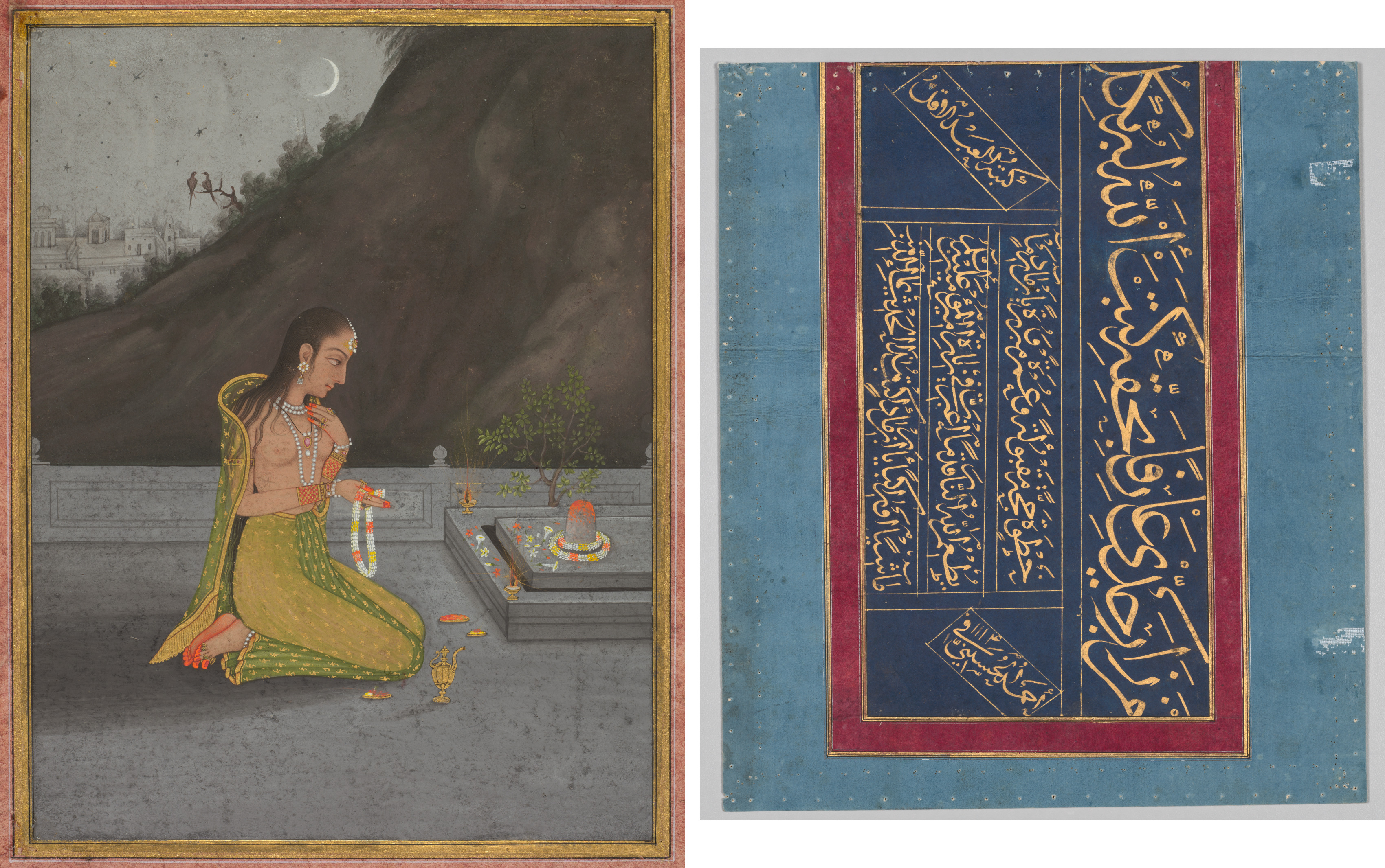

A night scene of Shiva puja (recto); Calligraphy (verso)
The image on the left shows a man with a yellow and green dhoti kneeling on a gray floor. He has a long dark ponytail and a mustache. He wears a necklace and bracelets, with a cloth draped over his shoulder. The man sits in front of a low stone platform holding a lit candle. A hill is behind him, with a crescent moon in the gray sky. A cityscape and trees are on the left side of the hill. The image on the right shows calligraphy on a blue background with a red border. The calligraphy is gold and appears to be in Arabic script. The calligraphy fills most of the blue area. There are four sections of calligraphy separated by lines. The background behind both images is white.
Artwork Details
- Dimensions
- 900 × 564 px
- Museum Record
- View original
You May Also Like

A prince conversing with a woman while taking refreshments on a terrace (recto); Calligraphy (verso)

A princess on a terrace with attendants at night (recto); Calligraphy (verso)

Leaf from the Late Shah Jahan Album: Harem Night-Bathing Scene (recto); Calligraphy Framed by an Ornamental Border of Flowers and Birds (verso)

Kabir and Two Followers on a Terrace (recto); Calligraphy (verso)

The unfaithful wife explaining away the presence of the dough elephant, from a Tuti-nama (Tales of a Parrot): Eighth Night

Bangali Ragini: Folio from a ragamala series (Garland of Musical Modes)

Bahram Gur Visits the Princess of India in the Black Pavilion, Illustration and Text, Persian Verses (recto); Bahram Gur Visits the Princess of India, Text Page, Persian Verses (verso)

A Night Scene of Shiva Puja (recto)

Folio 18 from a Chandana Malayagiri Varta (Story of King Chandana and Queen Malayagiri) of Karamachand: Ravana battles the great vulture Jatayu and defeats him by throwing stones in his mouth (recto); Jatayu approaches Rama and Lakshmana who are wondering where Sita could be (verso)

Left side of a double-page album folio: Outside a Royal Encampment (recto) and Calligraphy, Persian Verses (verso)

Kakubha Ragini

The Parrot Addresses Khujasta at the Beginning of the Seventh Night, from a Tuti-nama (Tales of a Parrot)

The Brahman’s wife who killed a peacock and ate its gallbladder on the physician’s advice, from a Tuti-nama (Tales of a Parrot): Nineteenth Night

Mirror of Holiness (Mir’at al-quds) of Father Jerome Xavier

The Parrot Addresses Khujasta at the Beginning of the Twenty-Fourth Night, from a Tuti-nama (Tales of a Parrot)

The parrot addresses Khujasta at the beginning of the forty-fourth night, from a Tuti-nama (Tales of a Parrot)

The Parrot Addresses Khujasta at the Beginning of the Eighteenth Night, from a Tuti-nama (Tales of a Parrot)

The Parrot Addresses Khujasta at the Beginning of the Eighth Night, from a Tuti-nama (Tales of a Parrot)

The Parrot Addresses Khujasta at the Beginning of the Thirteenth Night, from a Tuti-nama (Tales of a Parrot)

Kamjuy, the wife of the Raja, averts her face from the fishes, from a Tuti-nama (Tales of a Parrot): Twenty-third Night

Yusuf and Zulaykha (recto); Text Page, Persian Verses (verso)

Bhairavi Ragini: Folio from a ragamala series (Garland of Musical Modes)

The Raja’s son vows to sever his head and offer it to the image if he is united with the princess he has seen in the temple, from a Tuti-nama (Tales of a Parrot): Thirty-fourth Night

The origin of music from a fabulous bird of India which had seven holes in its beak, from a Tuti-nama (Tales of a Parrot): Fourteenth Night